

Last year, I wrote about how companies were facing a myriad of challenges going into 2024 and why investing in workplace culture (the key ingredient) was essential to addressing many of those obstacles.
As I step into 2025 with a mix of anticipation and anxiety, I’m reminded of a quote I first heard over 24 years ago at an important church meeting with my dad and brothers. A high-profile leader shared Harry Emerson Fosdick’s words, which, though it lingered quietly in the back of my mind for years, now seem to resonate more deeply as we lean into the next year.
“Men will work hard for money.
They will work harder for other men.
But men will work hardest of all when they are dedicated to a cause.”
We can now easily predict that natural disasters (wildfires ravaging entire regions, hurricanes intensifying in frequency, earthquakes devastating supply chains), global health challenges (similar to COVID-19, mental health epidemics, emerging infectious diseases), and technological breakthroughs (artificial intelligence, GLP-1 medications, quantum computing) will continue to disrupt markets and reshape industries.
Yet amid this turbulence, startup founders must remain anchored in their core purpose—they owe this clarity of mission to their customers, their employees, and, quite frankly, themselves.
Workplace culture often becomes either the silent driver of success or the overlooked cause of failure when confronting many of the challenges (see above). At the heart of a thriving culture lies Purpose—the “why” behind the organization’s existence.
Defined by a compelling vision, mission statement, codified values, and shared stories, Purpose serves as the compass that aligns teams, fuels innovation, and sustains momentum through challenges. I recognize how robotic and eye-rolling that previous sentence sounds. Yet, these elements are not ends in themselves but tools to achieve greater goals—solving customer problems, improving lives, or advancing society. This is what I’m really trying to get at which is the true measure of Purpose lies not in how eloquently it’s articulated, but in the meaningful impact it creates for those it serves.
Why Purpose Matters
Purpose isn’t just a feel-good concept; it’s a measurable driver of performance. Studies consistently show the value of purpose-driven organizations:
- 70% of the employees said that their sense of purpose is largely defined by work.
- Purpose-driven companies are 3X more likely to retain talent due to higher levels of employee engagement and job satisfaction.
- Purpose-driven organizations experience an annual return on equity averaging 13.1%, which is 9% higher than the S&P.
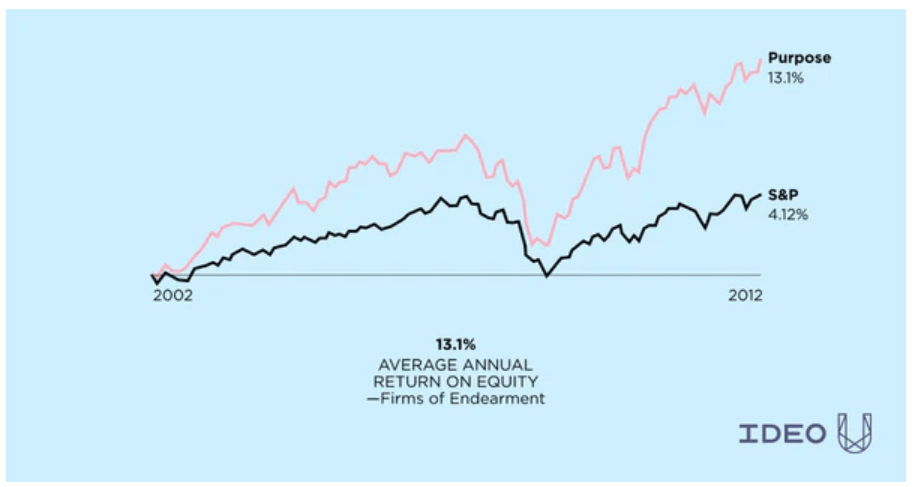
For startups, where resources are limited, turnover can be costly, and agility is essential, purpose serves as the north star guiding decision-making and team alignment.
The Key Elements of Purpose
1. Vision: A Glimpse of the Future
The vision statement paints a vivid picture of the world your startup seeks to create. It’s aspirational yet attainable, inspiring both employees and stakeholders.

Case Study: Patagonia‘s vision, “We’re in business to save our home planet,” transcends selling outdoor gear. This purpose drives their environmental initiatives, influences hiring, and resonates deeply with employees and customers alike.
2. Mission Statement: The Why and How
The mission statement operationalizes the vision, explaining the company’s core objectives and how they plan to achieve them. For startups, the mission clarifies focus in a sea of opportunities.

Case Study: Warby Parker Warby Parker’s mission, “to offer designer eyewear at a revolutionary price, while leading the way for socially conscious businesses,” combines practicality with purpose. Their “Buy a Pair, Give a Pair” program aligns with their mission and amplifies their impact.
3. Codified Values: The Behavioral Blueprint
Values act as the DNA of an organization, shaping how decisions are made and conflicts are resolved. Codifying values ensures they are actionable and integrated into daily operations.

Case Study: Canva exemplifies codified values with principles like “Empower Others” and “Pursue Excellence.” These values guide hiring, product design, and team collaboration, fostering a culture of creativity and inclusivity that resonates with employees and users alike.
4. Stories: Bringing Purpose to Life
Stories humanize purpose, connecting the abstract to the tangible. They inspire employees and create a shared cultural memory. Whether it’s the tale of a startup’s scrappy origins or an employee going above and beyond, stories reinforce purpose in meaningful ways.

Case Study: Airbnb In its early days, Airbnb shared stories of hosts’ pivotal experiences, from helping travelers find a home away from home to creating lifelong friendships. These narratives reinforced their purpose of “belonging anywhere” and built loyalty among hosts and guests.
Implementing Purpose in Your Startup

- Craft with Care: Involve key stakeholders in creating your vision, mission, and values to ensure authenticity and alignment. This process should include multiple people to avoid working in a vacuum.
- Embed in Operations: Too many companies create statements around purpose only to be hidden on a shelf that collects dust. Reflect your purpose in hiring criteria, onboarding, and engagement initiatives.
- Communicate Relentlessly: Regularly share compelling stories that highlight your purpose in action, whether this occurs during all-hands meetings or by utilizing internal newsletters as a distribution channel. Great companies are great story tellers. Be sure to identify culture champions within your team who have the ability to recall and retell those impactful stories effectively.
- Adapt Over Time: As your startup grows, revisit and refine your purpose to ensure it remains relevant. Bring back those key stakholders (step 1) to discuss what is working, what isn’t and how does it align with our overall purpose.
The Bottom Line

Startups whose founders focus on defining and living their Purpose build a strong and motivating workplace culture. Purpose is more than a statement online; it’s a key factor that encourages loyalty, innovation, and lasting success.
The future of work is about so much more than just chasing profits or crunching numbers—it’s about heart, purpose, and making a difference. It’s driven by a genuine commitment to sustainability, creativity, and caring for employees and communities. If you can’t take my word for it (speaking for millennials), just ask younger generations (Z and Alpha).
President Kennedy once addressed a graduating body of students and declared that as a nation:
“We choose to go to the Moon in this decade and do the other things not because they are easy, but because they are hard.”
This has to be one of my favorite quotes of the 20th century. Not because it talks about going to the Moon, but because it captures the essence of purposeful ambition. It reminds us that the greatest achievements come from embracing challenges with courage and determination. For startups, this means striving not just for quick wins but for meaningful impact—tackling the hard problems, innovating with intention, and creating value that resonates far beyond the bottom line.
After all, a cause worth fighting for isn’t a cause if it doesn’t stretch us.
Happy New Year, and here’s to building workplaces and businesses that inspire, challenge, and truly make a difference. May this next year bring purposeful growth, bold ambitions, and meaningful impact for us all.
Questions to consider:
For Startup Founders:
How do you ensure that your company’s purpose and values evolve alongside growth, and how do you keep them meaningful as you scale?
For Venture Capitalists:
When evaluating potential investments, how do you assess a startup’s commitment to its culture and purpose, and how do you factor this into your funding decisions?
For Both:
In a rapidly changing market, what’s more important for long-term success: the ability to pivot quickly or staying true to your original vision and values?

Article was written by John-Miguel Mitchell who is the Founder and Lead Consultant at Ekipo LLC. If you’d like to learn more about how to design and build out the ideal workplace culture for your business, email him at jmitchell@joinekipo.com.
Liked the blog? Get new content delivered directly to your inbox every Thursday & Friday.
 Ekipo
Ekipo 