
Read and written by John-Miguel Mitchell
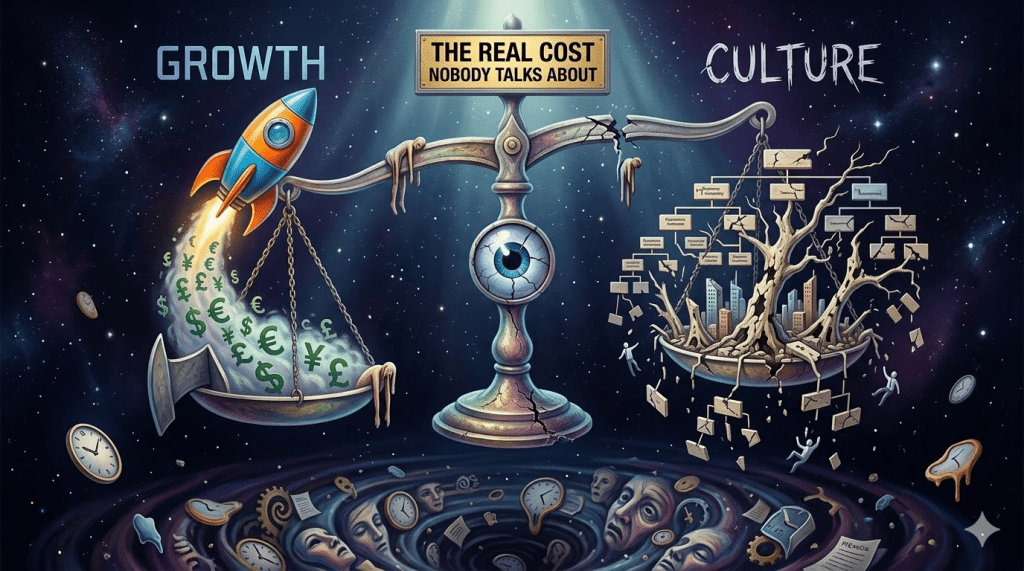
“Growth reveals. It doesn’t transform.”-an Ekipo staff member.
Why the fastest-scaling startups are the first ones to lose what made them great.
Whatever is already broken in your culture — the misalignment, the unspoken resentments, the values you claim but don’t actually live — growth doesn’t fix any of it. It exposes it. Amplifies it. And by the time you see it clearly, you’re already behind.
I learned this not from a case study, but from a conversation.
I recently sat down with a Chief Strategy Officer at a venture-backed AI startup doing genuinely interesting things in the mixed reality space. Great conversation — until I brought up workplace culture.
He minimized it. “Yeah, sure — culture matters. We need work-life balance, no toxicity. But the main priority is growth. I just don’t see it any other way.”
I pushed back. He interrupted: “Or else what?”
I said: “Or else you won’t have a company.”
Not my most eloquent moment, especially since I’m not really good with confrontation — just ask my wife. But walking away, I realized his definition of culture was so shallow he couldn’t see it was already the thing holding his company together. Scale past it without intention, and it becomes the thing that tears it apart.
Because every founder scales something. The question is what.
Culture Is Not What You Think
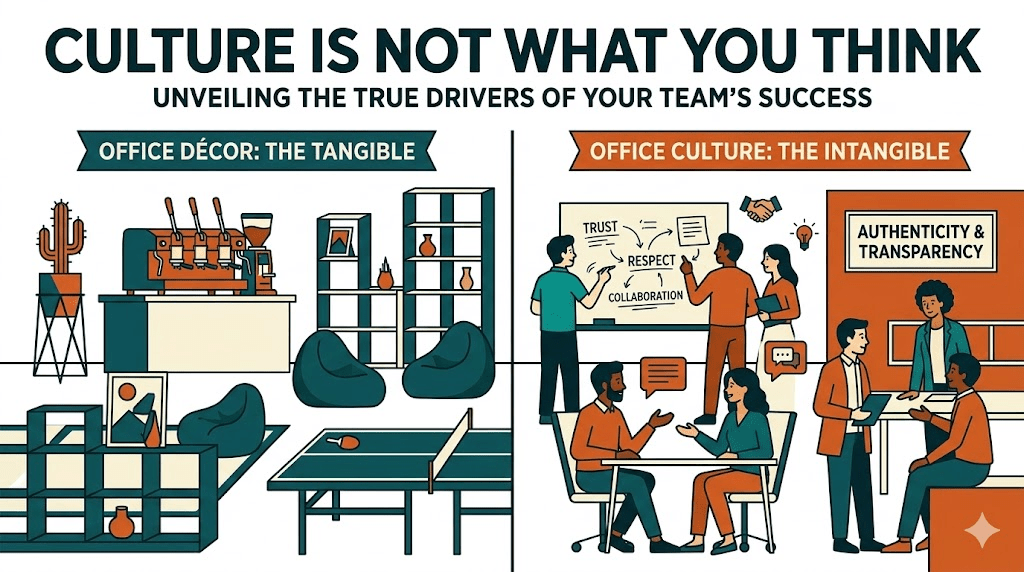
Most founders think culture means perks, vibe, or the absence of toxicity. Free lunches. No jerks. A Slack channel for memes.
That’s not culture. That’s décor.
Culture is the operating system of your company. It’s the invisible decisions your team makes when you’re not in the room. Who gets promoted and why. Whether people flag problems early or bury them. Whether your best performers stay or quietly update their LinkedIn.
At five people, culture is instinct. At fifty, instinct breaks. And the data is brutal: MIT Sloan research found a toxic workplace culture is 10.4 times more likely to drive attrition than pay issues. In fact, 65% of high-potential startups fail due to leadership dysfunction — dysfunction with cultural roots.
Culture isn’t adjacent to your growth strategy. It is your growth strategy. And the ones who treat it as a footnote are the ones who end up wondering why their best people left.
The Three Ways Scaling Kills Culture
Understanding what culture actually is only matters if you understand how easily — and quietly — it dies under pressure.
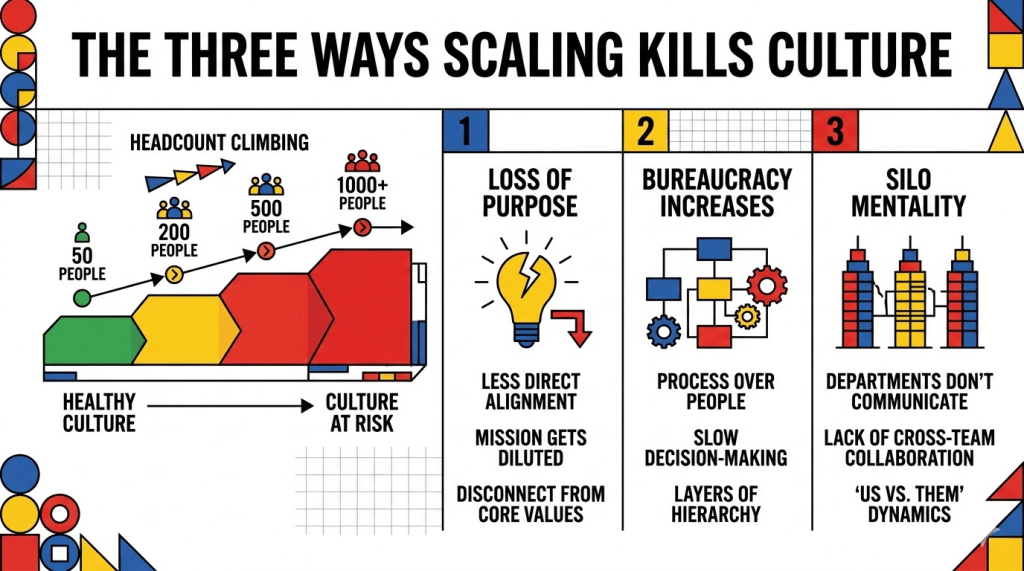
The real risk of rapid growth isn’t competition or capital. It’s culture drift — and it moves in three stages so quiet you’ll miss them.
① Silent Erosion. Nobody decides to abandon your values. A manager makes a shortcut hire. A founder celebrates a win that came at the team’s expense. Culture erodes in the absence of attention, not the presence of bad intent.
② Lack of Discipline. Speed becomes the excuse. “We’ll fix onboarding next quarter.” Every deferred culture decision is a withdrawal from an account with a limit.
③ Lack of Shared Philosophy. Past 50 employees, founders lose visibility. Hiring outpaces leadership systems. New people arrive with different mental models of “good” — and nobody hands them yours.
The result? Internal chaos disguised as growth. The metrics look fine. Headcount is climbing. But underneath, something critical is fracturing.
CD Baby founder Derek Sivers built one of the most successful independent music platforms of its era — then watched it slip. His own words: “I let the culture get corrupted.” He stepped down as CEO and eventually sold the company. (IMD, February 2026)
That’s the drift. And once it sets in, it’s extraordinarily expensive to reverse. Which brings us to what it actually costs.
The Real Cost Nobody Talks About
Culture problems don’t show up on your dashboard — they show up in your exits, your execution, and your next board meeting.
Expensive mis-hires. When values aren’t codified, you hire on vibes. The wrong leadership hire costs 1.5–3x their annual salary in recruiting, severance, and lost productivity — before you count the cultural wreckage.
Execution lag. Process can’t keep up with headcount. Product velocity slows as coordination breaks. The team is doing more but delivering less.
Internal chaos disguised as growth. Revenue is up. Headcount is growing. But your best people are burning out and your managers are improvising values they were never taught.
Khosla Ventures partner Ethan Choi recently flipped his investment philosophy to 90% founders, 10% metrics — because the only constant is how quickly a team can adapt. (Crunchbase News, March 2026) Culture is the vessel that either contains that adaptability or lets it leak out.
In a world chasing growth, execution dies cultureless.
So what do you actually do about it?
The Fix: Your Cultural Operating System
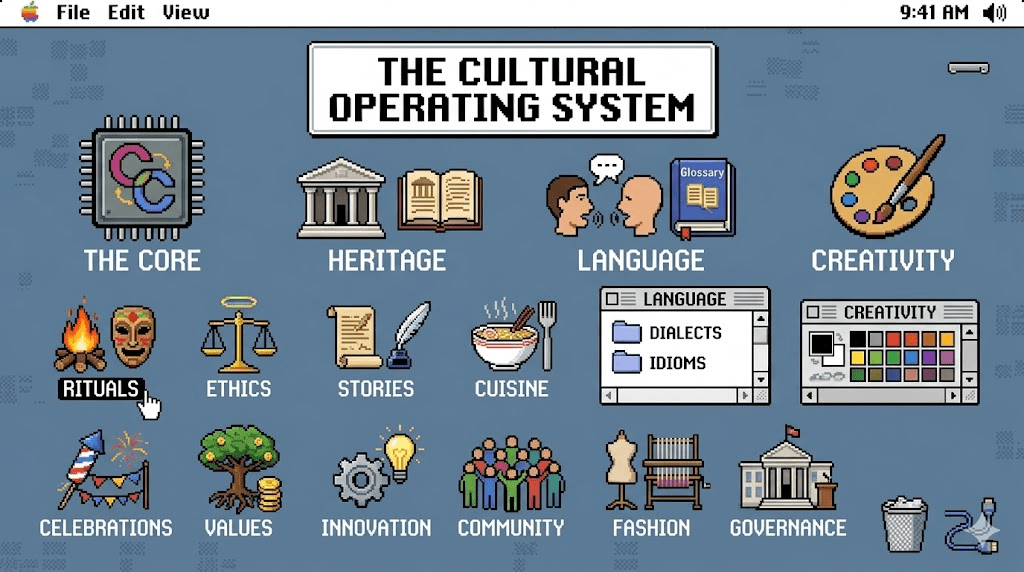
Culture isn’t built with a values workshop or a deck. It’s built with what I call a Cultural Operating System (COS) — a codified, deployable framework that protects your DNA as you grow. Something you build once, refine continuously, and deploy to every new hire from day one.
A real COS has five components:
| Component | What It Means | The Test |
| ①Teachable Behaviors | Values as actions, not adjectives | What does “ownership” look like at 3pm on a Tuesday when something breaks? |
| ②Decisions | Your decision framework is your culture made operational | Who has authority over what — and does everyone know it? |
| ③Rituals | Recurring moments that make culture visible and repeatable | How do you run all-hands, celebrate wins, handle failure? |
| ④Hiring Signals | Specific patterns that tell you someone will strengthen culture vs. corrode it | Are your recruiters screening for this — consistently? |
| ⑤Performance Criteria | You reward what you actually value | If you promote individual contributors but claim to value collaboration, your real culture is on the org chart — not the website. |
Building the COS is the long game. But there are things you can do right now.
Where to Start
This week: Audit your last five promotions. Did they reward the values you claim — or the behaviors you actually tolerate? The pattern tells you more than any survey. Then write down one unteachable behavior — the thing that gets someone let go here regardless of performance. If you can’t answer that, your culture has no floor.
Before your next hire: Ask whether this person makes you better at who you are — or just fills the seat. Skills can be taught. Values drift can’t easily be reversed.
Before you hit 30 people: Build your COS. Protect your early team — they carry institutional memory nobody else has. The moment they feel like outsiders in the company they helped build, you’ve lost something irreplaceable. And treat culture like a product: gather signal, spot bugs, iterate. The founders who preserve culture through scale never stop asking — is this still who we are?
The Bottom Line

The Chief Strategy Officer I spoke with wasn’t a bad leader. He was operating with an incomplete map.
He thought culture was about vibe and work-life balance. What he was describing was décor — and décor doesn’t hold a company together when you double headcount in eight months.
Growth and culture aren’t in competition. They’re in conversation. Stop managing that conversation, and the market manages it for you — through turnover, execution lag, and the erosion of everything that made your early team believe in you.
So the next time someone asks: culture or growth — or else what?
Or else you scale chaos. And chaos doesn’t IPO.
Every founder scales something. The question is what.
Three Questions Every Founder Should Sit With
- If your top five employees left tomorrow, would the people who replaced them even know what made your company worth joining?
- You can name your product roadmap for the next 12 months — can you name the three cultural behaviors that will make or break it?
- When was the last time you were honest with yourself about whether your culture is something you’re building — or something you’re just hoping survives?

Article was read & written by John-Miguel Mitchell who is the Founder and Lead Consultant at Ekipo LLC. If you’d like to learn more about how to design and build out the ideal workplace culture for your business, email him at jmitchell@joinekipo.com.
Liked the blog? Click on the subscribe button below to get new content delivered directly to your inbox every Friday.
 Ekipo
Ekipo 