
Read & Written by John-Miguel Mitchell

Executive Summary: The Data Behind Location Choices
Space policy is trust policy. Companies that don’t understand this lose 33% more talent.
The numbers from Stanford’s research on 1,612 employees:
- Hybrid work cuts turnover by 33%—but only when designed as trust signal, not mandate (Stanford study)
- Biophilic design increases productivity 15%, creativity 15%, wellbeing 15% (Human Spaces Global Study, 7,600 workers across 16 countries)
- 80% of employees stay longer with flexibility; rigid RTO mandates signal leadership fragility
If you’re mandating RTO without redesigning your office, you’re not building culture—you’re broadcasting distrust.
Why your office layout reveals more about your culture than your mission statement ever will
“A hotel should relieve travelers of their insecurity and loneliness. It should make them feel warm and cozy.” – Bill Kimpton, founder of Kimpton Hotel and Restaurant Group
Everyone has a horrible hotel story they’ll never forget.
The mystery stain on the carpet that you noticed too late. The elevator buttons so grimy and worn you held your breath before pressing them—or worse, the shuddering cable that made you wonder if this would be your last ride. The smell that hit you the moment you opened the door, something between mildew and despair that no amount of complimentary air freshener could mask. The breakfast “buffet” of stale bagels and watery coffee served in a fluorescent-lit cave. The shower with two settings: scalding or freezing. The neighbors. I can go on and on.
You remember these hotels not because they were expensive or cheap, but because every detail screamed the same message: We don’t care about you. You’re just passing through.
And you never went back.
Now think about your workplace. Your office, your Slack channels, your Zoom rooms. What are they screaming? When someone walks through your door or logs into their first company all-hands, are they experiencing the Four Seasons—where every detail signals care, intention, and belonging? Or are they in that roadside motel where the “free Wi-Fi” doesn’t work and the ice machine has been broken since 2019?
Just as hotels succeed or fail based on location, your workspace—whether physical, virtual, or temporal—determines who joins your company and who stays. The best founders understand this instinctively: they architect their “location” the same way Four Seasons selects where to build. Deliberately. Strategically. With full awareness that location determines experience, and experience determines everything.
Your Office Isn’t Culture. It’s the Test.

Most founders think backward about workplace design. They hire people, build culture through values and mission statements, then design an office to “reflect” that culture. Here’s the truth: Your workspace doesn’t reflect your culture. It reveals it.
Every physical artifact tells a story. The empty desk tracked by badge swipes. The executive floor that contradicts your “flat hierarchy” claim. The Zoom room where remote participants are second-class citizens, watching a tennis match of heads turning. The cluttered Slack channels with no clear ownership. The meeting rooms named after company values that no one can book. The motivational poster peeling at the corner that everyone walks past without reading.
These aren’t cultural misalignments. They’re culture confessions. Your physical layout, your virtual architecture, and your visible artifacts tell your team exactly what you actually value—regardless of what your company handbook claims.
The companies winning the talent war in 2026 aren’t the ones with the best cornhole tournaments or the most expensive espresso machines. They’re the ones who understand that space policy is trust policy—and they’ve architected their physical layouts, virtual environments, and visual artifacts as intentional strategic choices, not afterthoughts.

This is why hotels are the perfect metaphor. A hotel near the airport serves business travelers. One overlooking Santorini attracts transformation-seekers. Forgive me if the previous sentence sounds cheesy. The Four Seasons architects where to create what experience for whom. Every detail—from lobby art to room layout to digital check-in—is a deliberate signal. Your workplace operates identically.
The Five Questions Every “Location” Answers

When someone walks into your office or logs into Slack, they’re evaluating your “location” before they even realize it. These are the questions running through their minds:
1. What do you want me to feel here? Energized? Focused? Observed? Trusted?
2. Are there objects, rituals, or visuals that symbolize your culture? Or is this generic tech-company cosplay—exposed brick, bean bags, and motivational posters? Do the artifacts on display (awards, photos, artwork) reflect what you actually value, or what you think looks good on Instagram?
3. Does this space encourage collaboration or create silos? Can teams actually work together, or are they separated by walls, floors, and permission structures?
4. Is there anything visible sending the wrong message? Empty desks tracked by badge swipes? Zoom rooms where remote participants watch a tennis match of heads turning? Executive floors that contradict your “flat hierarchy” claims?
5. How intentional have you been about your virtual workspace? Is Slack clarity or chaos? Can remote participants contribute equally, or are they digital second-class citizens?
These aren’t rhetorical questions. Candidates are filtering companies based on workspace philosophy before they even apply. Your “location” is speaking louder than your job posting.
So what does strategic location selection actually look like in practice?
Let’s examine three companies that made deliberate choices about where to build their cultures.
Three Companies That Chose Their “Locations” Strategically
Airbnb—Location as Identity
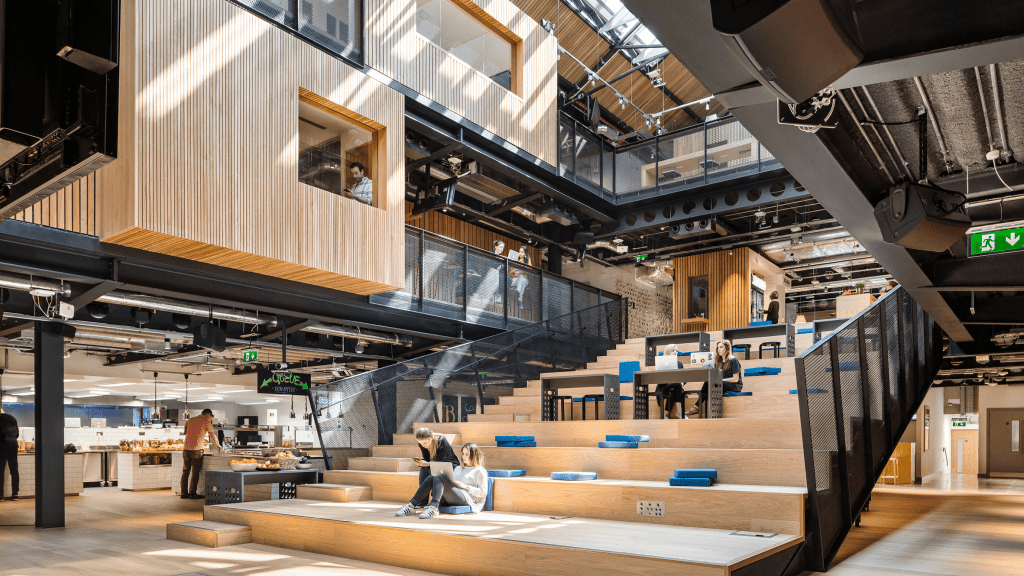
Airbnb‘s headquarters, designed by Gensler, doesn’t have conference rooms—it has meeting spaces modeled after actual listings worldwide. Their Beijing office recreates an Airbnb in Santorini, Greece, complete with a plaque identifying the actual property. The walls display photos from actual host homes. Meeting rooms are named after neighborhoods where Airbnb operates, not abstract company values.
The strategy: Employees work in spaces that embody “belonging anywhere.” No private offices exist, even for founders. Every physical artifact—from furniture sourced from listing locations to walls painted in colors from actual Airbnb properties—operationalizes the mission. The environment isn’t decorated. It’s designed.
The result: #1 in Glassdoor’s Best Places to Work (2016), 180,000 CVs for 900 positions. When Airbnb went “digital by design” in 2020, 56% of staff relocated beyond commuting distance—but quarterly in-person gatherings remain non-negotiable.
The lesson? Airbnb didn’t just talk about belonging. They built it into every square foot, every visual artifact, every layout choice.
GitLab—The All-Remote “Location”

GitLab has no offices. Over 1,300 team members across 65+ countries work from chosen locations, supported by their legendary 2,000+ page company handbook—a living document that serves as their virtual headquarters.
The strategy: Documentation is infrastructure. Virtual artifacts replace physical ones. Every process, decision, and value lives in their handbook, which receives hundreds of daily improvements. Their Slack channels follow strict naming conventions. Meeting notes are public by default. Transparency isn’t a value—it’s a visual architecture enforced through digital layout.
The result: GitLab scaled to multi-billion dollar valuation with zero real estate. They invented “coffee chats” to replace spontaneous connections and hold annual company-wide meetups for in-person collaboration.
GitLab proves that “location” can be temporal rather than spatial—but it requires the same strategic rigor as designing a physical headquarters. Their virtual artifacts (the handbook, the documented processes, the public channels) are as carefully architected as Airbnb’s physical meeting rooms.
Patagonia—Location as Values Manifestation

Patagonia’s Ventura headquarters features on-site childcare, organic cafés, and a policy forbidding meetings during lunch because employees are surfing, running, or doing yoga. The surf report is posted in the lobby—not buried in an app, but physically displayed where everyone sees it. Wetsuit racks line the hallways. The campus reflects their “Let My People Go Surfing” philosophy through every visible artifact.
The strategy: “Let My People Go Surfing” is policy, not metaphor. When waves are up at nearby C Street, employees head out—and the physical layout supports it. The company offers 15 different schedules for warehouse workers and 9/80 schedules for corporate staff (nine-hour days Monday-Thursday, eight hours every other Friday, with three-day weekends). No private offices. No executive parking spots. Every layout choice reinforces egalitarianism.
The result: Corporate turnover is only 4% versus 27% nationally. They receive 9,000 applications for few openings. A $3 billion company that commits 1% of sales to environmental groups.
Founder Yvon Chouinard has no private office. When employees see wetsuits in the office, the surf report on the wall, and flextime actually respected through visible daily behavior, they know culture is real—not performative.
These three examples share a common thread: they designed their physical layouts, virtual artifacts, and visual symbols to operationalize their values, not just decorate them. The artifacts tell the story before anyone speaks. But strategic location choices go beyond case studies.
Let’s break down the specific strategies that turn workspaces into talent magnets.
Location Strategy #1: Hybrid as Trust Signal
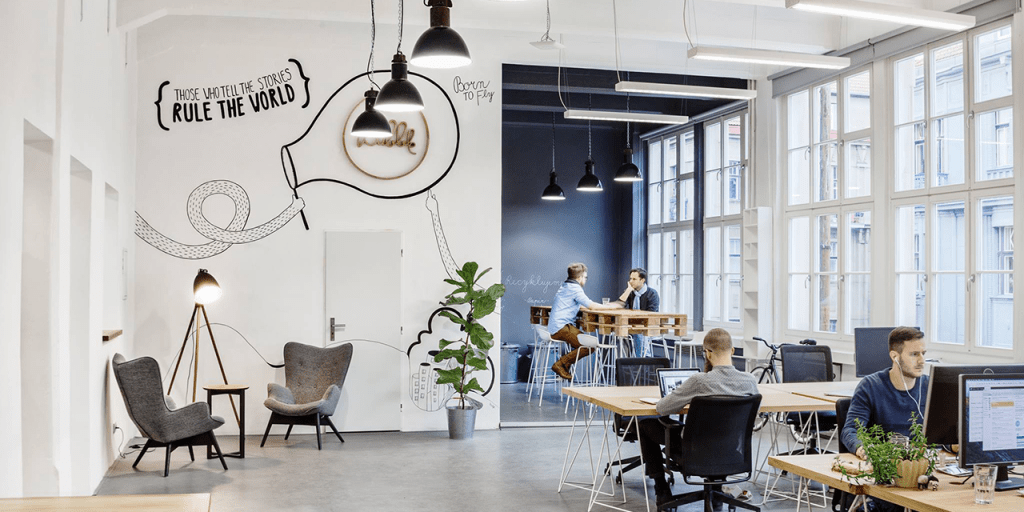
Stanford research found hybrid work reduced quit rates by one-third—but only when designed as trust, not surveillance.
High-trust: Hoteling systems, flexible layouts worth the commute, no badge tracking. Low-trust: Mandated office days, empty assigned desks, “we need to see you working” surveillance.
A hotel that locked guests in rooms would be empty. Companies forcing rigid RTO are choosing the wrong location.
Location Strategy #2: Biophilic Design Drives ROI
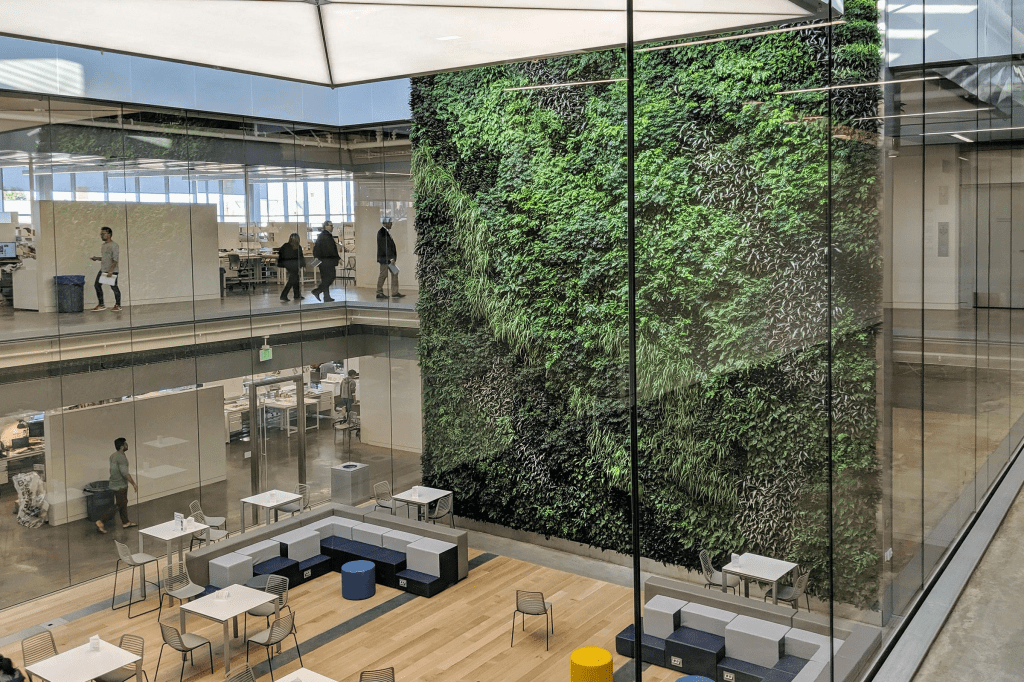
The Human Spaces Global Study (7,600 workers, 16 countries): natural elements increase productivity 15%, creativity 15%, wellbeing 15%.
What matters: Natural light, strategic greenery (even houseplants boost productivity 15%), views of nature, biophilic materials. Hotels charge premiums for nature views. Your office should too.
Location Strategy #3: Virtual Space Needs the Same Rigor

Hybrid workers spend $61/day commuting. If your virtual workspace is chaotic and excludes remote participants, you’re charging them $61 for a worse experience than staying home.
What works: Multiple camera angles, digital whiteboards accessible to all, Slack with clear naming conventions and regular audits, equal audio/video quality, visual artifacts that mirror physical spaces.
When Shopify went “digital by design,” they canceled 12,000 meetings. Does your remote experience match your in-office experience?
For Fully Remote Founders: Your “Location” Is When You Gather
GitLab’s success: intentional annual meetups for connection (not transactions) plus virtual infrastructure—automated coffee chats, async channels, transparent handbook-driven decisions.
Your “location” is gathering quality plus daily virtual texture. Random Zoom fatigue signals you haven’t chosen your location—it’s chosen you.
Location Strategy #4: Leadership Behavior Is Your Signage
Patagonia: CEO has no private office. Wetsuits in hallways, surf report on walls, empty CEO desk (he’s surfing).
Airbnb: No executive floors, meeting rooms as actual listings, leadership in open spaces.
Alignment between environment, behavior, and stated values = cultural integrity. Misalignment = culture debt—the compounding gap between what you claim and what your space communicates. Like technical debt, it accrues interest: every day leadership contradicts the environment, trust erodes exponentially.
For VCs: Look at where executives sit, what’s on walls, which Slack channels they join. Misalignments are retention risks.
The Counterargument: “But What About Scrappy Startups?”
“This is privileged advice. We’re in a WeWork with folding tables. We can’t afford Gensler.”
You’re confusing expensive with intentional.
Airbnb’s first office was Chesky’s apartment. GitLab: zero real estate. Patagonia: a tin shed. None started with budgets. All started with choices.
How do you arrange your folding tables—rows (hierarchy) or circles (collaboration)? What artifact tells your origin story? Is your Slack organized or abandoned? Do meeting rooms have generic names or reflect your mission?
The best “locations” aren’t determined by budget. They’re determined by whether every visible choice—$2 plant, CEO desk location, Slack channel names—reinforces what you’re building.
The tell: If you’re defending your “location” by saying “we can’t afford better,” you’ve already lost. The question isn’t cost. It’s whether you’re choosing your location, or letting WeWork choose it for you.
Culture debt accrues when founders outsource decisions to defaults—not when they lack capital.
Location Determines Who Stays

Airbnb, GitLab, Shopify, and Patagonia built multi-billion dollar companies by treating workspace as strategic infrastructure. They chose locations—physical, virtual, and temporal—that operationalized their missions.
For founders: Design workspace as intentionally as your product. It’s infrastructure for culture and a direct predictor of whether your best people stay.
For VCs: Look for founders whose physical spaces, virtual environments, and daily behaviors reinforce the same values—it’s the strongest predictor of scalable cultural integrity.
Your space is never just space. It’s a location choice.
And like every hotel executive knows: location, location, location.
Questions For Every Founder
1. If a candidate walked through your office (or joined your Slack) unannounced today, what would the physical artifacts and virtual channels tell them about what you actually value?
2. Where is the gap between your stated culture and your visible environment the widest—and why haven’t you fixed it yet?
3. If you removed all your company branding, signage, and stated values—could someone correctly guess your culture just from observing your physical layout and virtual architecture for one week?
4. The best hotel locations evolve with their guests. Is your workspace strategy stuck in 2019, optimized for a team that no longer exists—or are you building the “location” that will attract and retain the talent you need for 2026?

Article was read & written by John-Miguel Mitchell who is the Founder and Lead Consultant at Ekipo LLC. If you’d like to learn more about how to design and build out the ideal workplace culture for your business, email him at jmitchell@joinekipo.com.
Liked the blog? Click on the subscribe button below to get new content delivered directly to your inbox every Friday.
 Ekipo
Ekipo 
Leave a comment