
Read & Written by John-Miguel Mitchell

How Founders and VCs Should Navigate the Worst October in 22 Years as We Head Into the Holidays
I’ll never forget my last day at Spencer Stuart.
Long story short, with less than 3 weeks from Christmas, I was fired by the firm of my dreams. I was shocked.
To be honest, 7 years later, I’m still pissed about it and don’t like to talk about it very much cause I envisioned so much for myself, my family and my career. I had never been fired before so the only thing I could think of when I met with the managing director of the LA office that day was, “I’ll be back; either as a consultant, a client or competitor, but I’ll be back.” Silly, I know, but what else could I say?
I remember checking my bank account that night. Calculating how long I could last. Wondering what I’d tell my family in those early days before Christmas.
To be clear, getting fired is different from getting laid off. However, they share the same core impact on the employee receiving the news.
You lose your income. Your identity takes a hit. You feel like you’ve lost control. The experience exposes culture quality—how leadership communicates, supports, and transitions people out reveals everything about a company’s integrity. It forces a career reset. It tests leadership. And it creates a story you now have to tell going forward.
Not all layoffs are handled the same way. Some companies offer 20 weeks of severance, equity acceleration, and career coaching. Others offer two weeks and a coldly worded email. Some founders write LinkedIn recommendations for every departing employee. Others have security escort people out in 15 minutes.
That experience—getting fired three weeks before Christmas—taught me more about leadership than any MBA could. It showed me what happens when companies treat exits as transactions instead of transitions.
And now, as October 2025 delivers the worst layoff numbers in 22 years, I’m watching thousands of founders make decisions that will define their companies for the next decade.
Your Management Structure Matters More Than Your Severance Package
Here’s what founders and VCs consistently underestimate: The way you communicate layoffs in November and December determines whether your survivors stay through June 2026.
Companies with highly committed employees see the largest drops in engagement after layoffs. Trust damage can persist for up to 15 years. There is no such thing as an “engagement rebound“—engagement among employees present at layoffs generally doesn’t return to pre-layoff levels.
Layoffs don’t just test your balance sheet. They test whether your management structure—the invisible wiring of how decisions are made, communicated, escalated, and shared—is real or performative.
The companies that clarify decision-making frameworks, transparency boundaries, and escalation paths during November-December layoffs are the ones still executing in 2026.
The companies that don’t? They spend all of 2026 trying to repay cultural debt they created in 48 hours.
People don’t remember the layoff. They remember the leadership.
So let’s look at what just happened—and why this October matters more than any other in recent memory.
What Just Happened: October 2025 as an Inflection Point
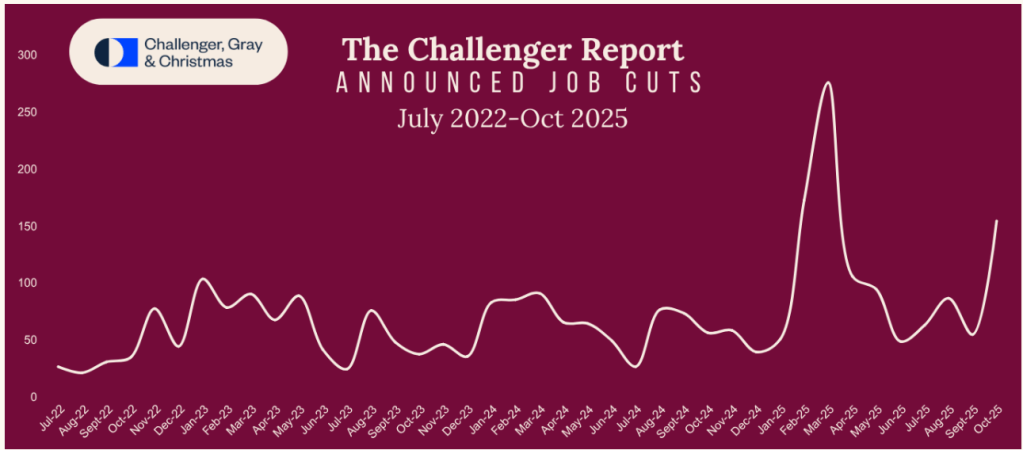
October 2025 shattered a decades-old social contract. For the first time since 2003, companies ignored the unwritten rule: you don’t do mass layoffs right before the holidays.
The Numbers:
- October 2025: 153,074 layoffs (most since October 2003)
- Tech sector in October alone: 33,281 layoffs (up from 5,639 in September)
- Warehousing industry: 47,878 cuts in October (up from 984 in September—a 378% year-over-year increase)
- Planned hiring through October: 488,077 (down 35% from last year, lowest since 2011)
What This Means
Your laid-off employees face the worst job market in 14 years. Those who leave now are finding it significantly harder to secure new roles. Analysts don’t expect a strong seasonal hiring environment in 2025.
The AI Reality
AI was cited in 48,414 layoffs so far this year. In October alone, 31,039 cuts were attributed to AI-related restructuring—the second most common reason after general cost-cutting.
- Klarna CEO Sebastian Siemiatkowski: headcount shrunk by ~40% in part because of AI
- Duolingo: stopped using contractors for work AI can handle
- Salesforce: laid off 4,000 customer support roles, saying AI can do 50% of the work
The Unwritten Rule Just Broke
Here’s the cultural shift founders need to understand from Andy Challenger,
“Over the last decade, companies have shied away from announcing layoffs in the fourth quarter, so it’s surprising to see so many in October. With the onset of social media, and the ability for workers to share their negative experiences with their employers, the trend of announcing layoffs before the holidays fell away, a practice that seemed particularly cruel.
At a time when job creation is at its lowest point in years, the optics of announcing layoffs in the fourth quarter are particularly unfavorable”.
For Founders: When you tell laid-off employees “you’ll land on your feet,” they know—and your remaining team knows—it’s not true. Address this reality or lose all credibility.
So what happens to the people left behind? What questions are they asking right now in Slack channels and during nervous coffee breaks?
The Real Damage Isn’t the Layoff—It’s the Management Void It Creates
When 153,000 people lost jobs in October, millions more started asking questions inside their companies:
- “Who’s actually making the decisions now?”
- “Is this intentional, or are we improvising?”
- “How did leadership decide who stayed and who left?”
- “What information is being shared with us, and what’s held back?”
- “Is it still safe to escalate concerns or challenge decisions?”
- “Who will mentor me if half the org has changed?”
These are management structure questions. And they determine whether culture stabilizes or fractures.
During the holidays—when people are already emotionally stretched and about 40% of Americans go into debt for holiday expenses—these questions hit even harder.
These aren’t abstract concerns. The research on what happens after poorly handled layoffs is devastating.
The Cost of Getting It Wrong: What Dies When You Cut
When layoffs are mishandled, the data is brutal:
- 41% decline in job satisfaction among survivors
- 36% decline in organizational commitment
- 20% decline in job performance
- Studies show that downsizing a workforce by just 1% leads to a 31% increase in voluntary turnover the next year.
- Even 15 years after layoffs, surviving employees may still be 4.5% less trusting
What actually collapses:
- Institutional wisdom
- Informal mentors and collaboration bridges
- “Who to ask for what”
- Psychological safety to escalate concerns
- Execution speed (months of productivity lost)
Employee productivity plummets and overall company performance suffers when workplace morale is deeply eroded.
So what does good leadership look like in this moment? And what does terrible leadership look like? Let’s examine two case studies that couldn’t be more different.
Company that got it wrong: Better.com—The Cautionary Tale Every Founder Should Study
In December 2021, Better.com CEO Vishal Garg fired 900 employees over a three-minute Zoom call—days after receiving $750 million in funding.
He called it in:
“If you’re on this call, you are part of the unlucky group that is being laid off…Your employment here is terminated effective immediately.”
The aftermath was catastrophic:
- VP of communications, head of PR, and head of marketing all resigned.
- A second layoff in March 2022 saw 3,000+ employees learn they were fired when severance checks appeared in their payroll app—no communication from leadership
- Former employees formed support networks on Blind and Slack with over 900 members to crowdsource problems normally handled by HR
- The company’s SPAC deal was delayed, valuation collapsed, reputation permanently damaged
What they got wrong:
- Zero communication strategy
- Blamed employees publicly (“you stole from me“)
- Handled logistics incompetently
- Destroyed all trust in a single call
The lesson: It wasn’t the layoff that killed Better.com’s culture. It was the void left by leadership that refused to lead.
Now let’s look at the opposite approach—a company that faced an even larger layoff but preserved trust and dignity throughout.
Company that got it right: Airbnb—The Gold Standard for Compassionate Layoffs
When Airbnb had to let go of almost 25% of its workforce in 2020, CEO Brian Chesky showed what intentional leadership looks like:
What they did right:
- Sent an open letter exemplifying transparency
- Owned the decision publicly (no euphemisms or blame)
- Offered comprehensive severance packages
- Reduced vesting caps so everyone could claim equity shares
- Extended health benefits for 12 months
- Created an Alumni Talent Directory to help people find jobs
- Treated departing employees with dignity
The result: Airbnb preserved trust with survivors, maintained their employer brand, and rebounded faster than competitors.
When leaders treat employees like valuable team members and explain rationale behind difficult choices, employees in high-trust environments are 75% less stressed, take 13% fewer sick days, and report 106% more energy.
So how do you actually do this? What are the practical steps founders can take right now, this week, to stabilize their teams?
The Path Forward: 5 Steps to Protect Your Culture When Letting People Go

Here’s what separates companies that stabilize from companies that fracture:
1. Re-Establish Who Makes Decisions—and Make It Intentional
Your team is already asking: “Who makes decisions now, day-to-day?” If they don’t know, rumors fill the gap.
Clarify explicitly:
- Who sets priorities
- Who approves changes
- Who controls cross-functional alignment
- Whether you’re centralizing or distributing decisions for Q4/Q1
Intentionality reduces anxiety. Ambiguity creates reactivity.
2. Explain How Decisions Were Made—Clearly and Without Euphemisms
Employees don’t need names or private details. They need the framework:
- What signals triggered the decision?
- What criteria guided the cuts?
- What’s stable going forward?
- What’s still uncertain?
Critical: Don’t blame AI. Don’t say “economic headwinds.” Don’t use corporate-speak.
Say: “We cut 15% of headcount because our burn rate was unsustainable at current revenue. We prioritized keeping customer-facing roles and core engineering. We’re now break-even through Q2 2026.”
Ambiguity is more damaging than bad news. Clarity is more stabilizing than good news.
3. Define What Information Is Transparent—and What Is Intentionally Held Close
Not everything can be shared. But when leaders don’t define the boundary, employees assume secrecy or chaos.
Say explicitly: “Here’s what we can share. Here’s what we can’t yet. Here’s why.”
When people understand the rules of transparency, they feel safer inside them.
4. Strengthen the Escalation Path—Fear Destroys More Alignment Than Failure
After layoffs, people question whether it’s still safe to raise concerns.
You need to reinforce:
- What issues should be escalated
- Who receives them
- How they’ll be handled
- What psychological safety looks like post-layoffs
Silence is not loyalty—it’s fear. Leaders must invite honesty back into the room.
5. Reinforce Mentorship and Knowledge-Sharing Before It Collapses
Layoffs often wipe out institutional wisdom overnight.
Establish immediately:
- Knowledge handoffs (documented, not assumed)
- Micro-mentorship pairings (1-on-1, 30-day commitments)
- Weekly sync-and-share moments
- Documentation rituals
AI can automate tasks—but it can’t replace mentorship. Recent college graduates face one of the toughest job markets in recent memory, with employers projecting only a 1.6% increase in hiring for the class of 2026. If your startup employs junior staff, they’re your most vulnerable population.
Now, I know what you’re thinking. I’ve heard every objection to this approach in boardrooms from San Francisco to New York. Let me address them head-on.
Pushbacks & Rebuttals from Founders and VCs

Below are the most common objections we hear in boardrooms from Silicon Valley to NYC, Austin, London, and LA—and the responses that actually cut through.
| Common Pushback From Founders & VCs | Rebuttal That Actually Lands |
|---|---|
| “We just need to get through the quarter. This emotional stuff can wait.” | Execution is emotional. Teams don’t hit milestones when they don’t trust decisions or leadership. Stability fuels speed. You’ll lose more time to turnover, disengagement, and rework than you’ll save by skipping transparent communication. |
| “We’re too lean right now. We don’t have time for transparency.” | Lack of transparency creates rework, rumor mills, and churn. That costs more time than clear communication ever will. One 30-minute all-hands saves 100 hours of confused Slack threads. |
| “AI made these cuts necessary. It’s not personal.” | AI may be the trigger, but communication is human. How you frame it affects culture, retention, and credibility. Blaming AI makes you sound like you’re not in control. |
| “People will move on after the holidays.” | They won’t. Emotionally charged seasons create long-term memory. Leadership in November–December sets the tone for 2026. Trust damage can persist for 15 years. |
| “We don’t need structure. We need speed.” | Speed without structure becomes chaos → chaos becomes culture debt → culture debt becomes financial debt. Investors know this. The fastest companies have the clearest decision-making frameworks. |
| “The job market is fine. They’ll land on their feet.” | Planned hiring through October is down 35% from last year—the lowest since 2011. Don’t lie to your team. They can see LinkedIn. They know it’s brutal out there. |
For VCs and Board Members: Your Portfolio Is Watching
Your founders are looking to you for guidance on how to handle this moment. What they need most: permission to be human, real talk on runway (help them cut once and cut deep—multiple rounds destroy more trust), and operational coaching on communication.
Most first-time founders have never done layoffs. Use your network to support laid-off employees. Make introductions. Write LinkedIn recommendations. And recognize that culture is operational, not sentimental—companies with strong management structures execute faster.
A Final Word: What Survivors Remember
I’ve never been laid off.
But I know what it feels like to come home not knowing what tomorrow will look like—especially when you have little ones counting on you.
When Spencer Stuart fired me three weeks before Christmas, I learned something I’ll take to my grave: How you let someone go matters more than when or why. You can’t avoid hard decisions, but you can control how much humanity you bring to them. I will never treat an exit as a transaction. I never want anyone to feel like a line item on a spreadsheet the way I felt that day.
You can’t get into the holiday spirit when you’ve just been handed a pink slip. Forget the eggnog. Forget the presents. Forget the funny sweaters. Forget being “present” with family when your mind is calculating runway, updating your resume, and rehearsing what you’ll tell your kids.
If we justify cutting 153,000 people in October—right before the holidays—without even pausing to ask how we communicate it, something is truly rotten in the startup ecosystem.
I’m not saying don’t do layoffs. I’m saying: if you have to do them now, during the hardest season of the year, then do them with intention. Do them with clarity. Do them like a leader who sees people, not just numbers.
Questions for Founders & VCs
- If we decide to cut roles in October–December, what story will this create inside our company — and am I prepared to own that story for years?
- Have we clearly defined the principles, criteria, and values guiding our layoff decisions — and can every employee say the process felt intentional rather than improvised?
- What parts of our management structure will break the moment we remove people — mentorship, institutional memory, cross-functional glue — and what am I doing to reinforce them now?
- If I were an employee watching this unfold, what signals would tell me it’s still safe to trust leadership, stay focused, and stay here?
- For VCs, what guidance am I giving my founders that reduces financial risk without creating cultural debt they’ll spend all of 2026 repaying?

Article was read & written by John-Miguel Mitchell who is the Founder and Lead Consultant at Ekipo LLC. If you’d like to learn more about how to design and build out the ideal workplace culture for your business, email him at jmitchell@joinekipo.com.
Liked the blog? Click on the subscribe button below to get new content delivered directly to your inbox every Friday.
 Ekipo
Ekipo 