

I have a confession that’s embarrassing for someone who writes about leadership: I’m terrified of deep water.
Throw me in the middle of a lake or ocean where I can’t see the bottom, and I’ll panic. It’s irrational, I know. But there’s something about not being able to see what’s beneath you — about being suspended in a space where the pressure increases with every meter you descend — that triggers something primal.
Which makes it ironic that the best metaphor I’ve found for what’s happening in AI right now comes from deep-sea diving.
There’s a quiet truth running through Silicon Valley right now — something founders whisper privately but rarely say out loud:
AI hypergrowth is happening at a speed faster than the human nervous system can adapt.
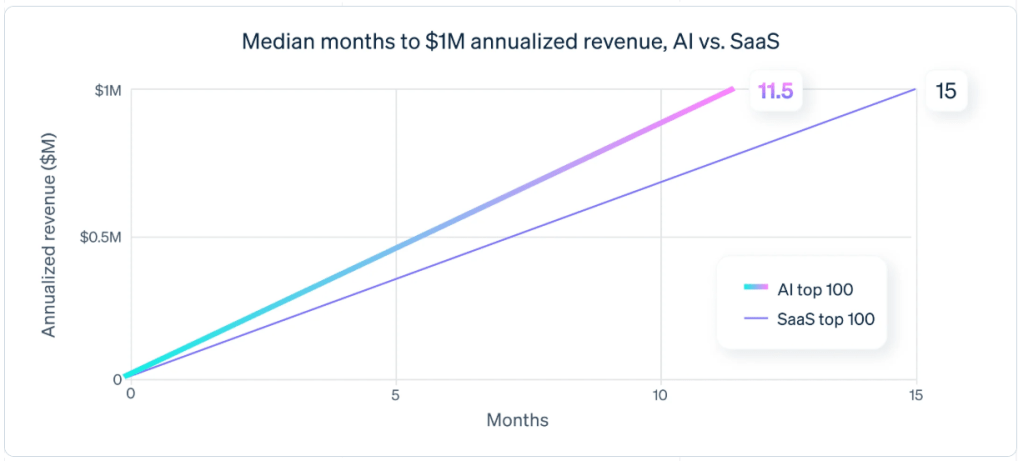
Stripe‘s latest report shows AI startups hitting:
- $1M ARR in 11.5 months
- $5M ARR in 24 months
- Bolt at $20M in 2 months
- Lovable at $17M in 3 months
- Cursor at $100M+ in 3 years
But here’s what those numbers don’t show: what they do to the people inside the companies.
The founders.
The teams.
The leadership systems that weren’t designed for this velocity.
And the psychological debt that compounds faster than revenue.
This is the part of the AI economy we rarely talk about.
The Decompression Problem
Deep-sea divers know: ascend too fast and nitrogen bubbles form in your bloodstream. In tech, we call this “making it.” In medicine, they call it the bends. Both can kill you.
My fear of deep water? It’s about losing control in an environment where the rules change the deeper you go. Pressure increases. Visibility drops. What felt manageable at the surface becomes lethal at depth.
That’s exactly what’s happening to founders in the AI boom.
AI startups are ascending faster than leadership systems can adapt. The winners won’t be the fastest—they’ll be the ones who pause to decompress before the culture debt becomes fatal.
The true differentiator in this era isn’t innovation.
It’s knowing when to pause.
When to decompress.
When to let leadership systems catch up to growth.
Because speed without decompression stops doesn’t create category leaders. It creates headlines—and then casualties.
The Headlines You Pretend Don’t Apply to You

In the past few weeks, three stories have swept through founder group chats from Palo Alto to Singapore:
- A founder allegedly billing JPMorgan for luxury hotel upgrades and “cellulite butter.”
Not fraud — judgment collapse under pressure. - Morning Brew’s “Forbes 30 Under 30 Hall of Shame.“
Talented young founders who went from hypergrowth → hype → headlines → disaster. - Jeff Bezos returning as co-CEO of Project Prometheus, a $6B AI venture.
Even the most operationally disciplined founder of our generation stepped back into the arena because AI’s velocity cannot simply be delegated.
And then there’s Mark Klein of SuRo Capital — investor in OpenAI, CoreWeave, Canva, Plaid — warning that AI valuations are:
“Tripling in months, not years, with little change in fundamentals.”
When the capital pace outruns fundamentals, it also outruns leadership maturity.
This is how otherwise good founders end up in bad stories.
What Ascending Too Fast Actually Looks Like: Team Pressure & Founder Burnout

Matt Munson built Twenty20 from zero to exit. On the outside, it looked like success. On the inside, he was drowning.
“I realized I was deeply unhappy in my role,” he wrote years later. “I was burned out and needed a change… Even with that clarity, it would be two and a half years before I would finally make that change. Two and a half years! I spent 30 months in a state of fatigue and burnout.”
He recounts what other founders told him in a single day:
- “My company just raised $100 million, and I want to quit. What do I do?”
- “We’ve launched in two countries. I want out but don’t want to leave the team unemployed.”
- “I’ve been at this six years. I’m tired. But I don’t think we can sell.”
- “I know I need to grind, but I can’t find my way back to the focus I used to have.”
That’s the bends at work. And it’s the same pattern that shows up across the most dangerous workplace challenge in scaling: team pressure and burnout.
The Founder Pressure Curve Has Become Inhuman

Here’s what doesn’t make it into the Stripe charts:
- You’re scaling faster than your identity can keep up.
- Your role is changing monthly.
- You’re making decisions with incomplete information at impossible speeds.
- You’re projecting confidence you don’t always feel.
- You’re carrying pressure the team cannot see.
- You’re terrified of losing momentum your valuation now depends on.
This is the emotional anatomy of AI hypergrowth.
Every founder knows it.
Few will admit it.
Because the story of AI success is still being written, but the story of founder overwhelm is being lived in private.
A 2024 survey of early-stage European founders revealed the scale of the problem: 53% experienced burnout, 49% were considering quitting their startup, 55% suffered from insomnia, and 85% reported high stress.
These aren’t weak founders. These are people ascending faster than their nervous systems can decompress.
Why This Matters Now More Than Ever
In overheated markets like AI, the decompression sickness happens faster because the ascent is faster.
Mark Klein — who’s seen multiple cycles — is holding cash on the sidelines because the market is “dangerously overheated.”
When valuations inflate too quickly, founders feel heightened pressure to “live up” to numbers they’re not structurally ready for. That pressure leads to shortcuts — operational, ethical, strategic.
Founders are hitting executive complexity 3–4 years earlier than historical norms. Leadership maturity hasn’t caught up.
And culture — the foundation most founders ignore measuring — deteriorates long before metrics do. By the time anyone notices the signals, the damage is irreversible.
Speed isn’t the problem. Speed without decompression is.
The Companies That Win Now Will Do Something Radical: Decompress Deliberately
If you want to separate yourself from the crowd — in Silicon Valley, New York, Austin, London, Singapore, or anywhere the AI boom touches — here’s the simplest playbook:
A Founder’s Quick-Win Culture Playbook
(To stabilize judgment, improve clarity, and protect execution in high-velocity markets)
| Timeframe | Action |
|---|---|
| Quick Wins (This Week) | Create a 10-item “Stop Doing” list |
| Introduce a 15-min Monday alignment ritual | |
| Identify 2–3 founder blind spots with your team | |
| Launch a simple “Red Flag” channel | |
| Short-Term (30–60 Days) | Install a decision-making model (RACI/RAPID) |
| Run a founder alignment reset | |
| Build a lightweight culture dashboard | |
| Long-Term (Quarter+) | Build a real leadership bench |
| Codify culture as operating principles | |
| Establish a founder accountability circle | |
| Upgrade ops maturity pre-fundraise |
This is how you build a company that stays exceptional while everyone else is simply accelerating.
The Only Sustainable Advantage Left in AI

Sure, we will continue to see headlines about bigger rounds and hype cycles. Unfortunately, this isn’t going away. But the next decade of AI won’t belong to the fastest founders—it will belong to the leaders who build decompression stops while everyone else ascends blindly.
Because in a dangerously overheated market, the real differentiator isn’t speed.
It’s knowing when to pause.
When to let leadership systems catch up.
When to pay down culture debt before it compounds into crisis.
Deep-sea divers know: you can’t skip the decompression stops. No matter how urgent the surface feels, no matter how much pressure is waiting for you above, ascending without pausing will destroy you from the inside out.
The same is true for founders in the AI era.
The nitrogen is already in your bloodstream. The only question is whether you’ll surface carefully — or become another cautionary tale.
That is the work no one sees — but everyone eventually feels.
Questions for Founders
- If your best hire from 18 months ago interviewed with you today, would you still be the company they said yes to?
- What’s the gap between what you tell investors about your culture and what your team would tell a reporter off the record?
- What would you have to admit about yourself to fix what’s actually broken in your company?
- Your valuation tripled, but can you name the last time you felt genuinely proud of how your team feels about working for you?

Article was read & written by John-Miguel Mitchell who is the Founder and Lead Consultant at Ekipo LLC. If you’d like to learn more about how to design and build out the ideal workplace culture for your business, email him at jmitchell@joinekipo.com.
Liked the blog? Click on the subscribe button below to get new content delivered directly to your inbox every Friday.
 Ekipo
Ekipo 