
Written & read by John-Miguel Mitchell
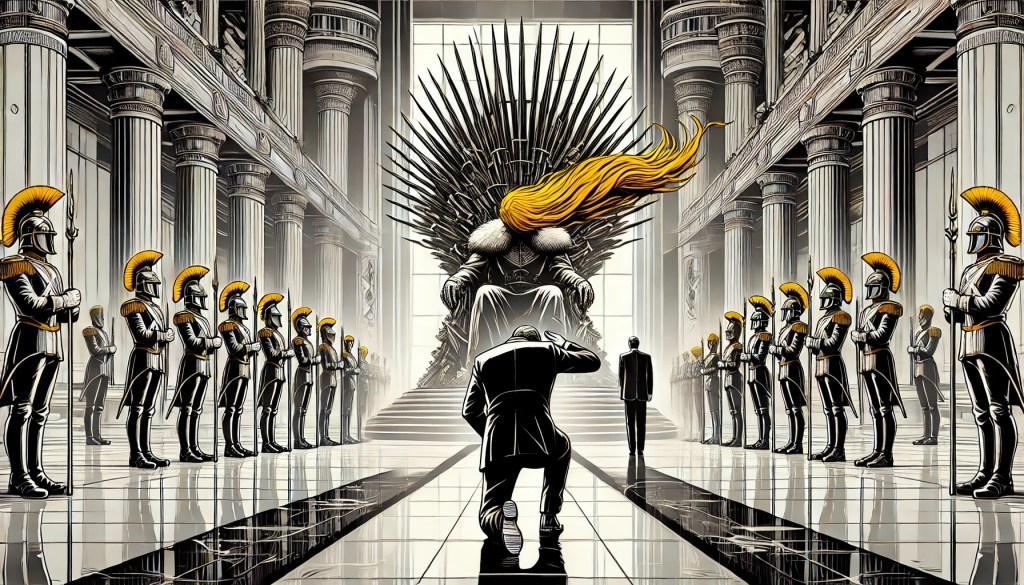
Last week, Tim Cook walked into the Oval Office and shook hands with Donald Trump.
This isn’t new.
Rewind a little and you’ll find a continued tradition of business leaders that have courted US Presidents. Republicans and Democrats alike have invited CEOs into the Oval Office for photo ops, praise, and partnership.
These visits are often transactional: access for influence, influence for access. Sometimes, they’re about genuine collaboration. Sometimes, they’re just about optics. But either way—they’ve always been part of the political playbook.
So let me jump right into why Mr Cook’s visit to the White House hit me harder than other guest appearances. That handshake wasn’t just a photo op—it was a values statement. And it was disgusting.
Here we have the CEO of Apple. One of the faces of modern innovation. The steward of one of the most admired brands on the planet. A leader who has navigated Apple through global supply chain dominance, fought for user privacy, and earned the respect of startup founders worldwide.
For founders, here’s the takeaway: every public moment sends a cultural signal to your team and your market. Choose the moment—and the signal—you want remembered.
And yet, there he was—cozying up to a convicted felon. A man found liable for sexual assault. A political figure who has undermined democracy, fueled division, and led with fear and fraud. That’s not neutrality. That’s complicity.
When leaders at the very top of Big Tech stumble, it’s more than a PR blip — it’s an opening. Moments like Tim Cook’s Oval Office visit with Donald Trump create space for startup founders to lead in a completely different direction: to reject the compromise, the calculation, and the cowardice, and instead show that courage and values can drive growth just as powerfully as capital and connections.
“It’s just business.” That’s the excuse.
We already know the rebuttal from Cook’s corner:
“This wasn’t about politics. It’s about protecting Apple. About shielding the company from tariffs. About reshoring manufacturing. About navigating the chaos of AI regulation.”
Just last week the Financial Teams praised Tim Cook’s effort by, saying “Apple wins reprieve from White House after pledge to increase spending by $100bn”.
That sounds strategic. Calculated. Responsible even.
But here’s the hard truth:
When you make deals with men like Trump, it’s never just business.
You don’t get to pick and choose which parts of him you endorse. You don’t get the deregulation without the disgrace.
Scott Galloway had a similar take back in April for the lack of pushback from Fortune 500 CEOs when he said:
“The key attribute of leadership is doing the right thing when it’s hard… business leaders are saying their fear and idolatry of the dollar trumps all. Their silence is cowardice.”
Here’s the visual that drives it home:
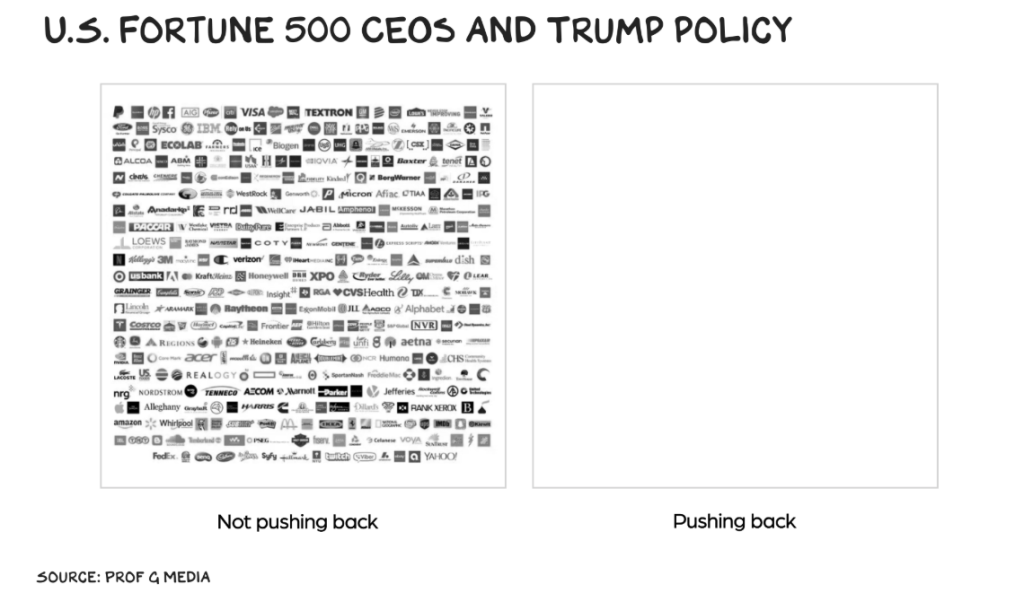
This wall of silence in the Fortune 500 should light a fire under founders. You don’t have their bureaucracy, PR constraints, or shareholder politics. You can move faster, speak louder, and lead with values. That’s your competitive advantage—don’t waste it.
And when one of the most powerful CEOs in the world shows up smiling in the Oval Office of a disgraced, twice-impeached, convicted figure—it sends a message to every founder, every employee, every investor: Money matters more than doing the right thing.
Of course money matters, but meaning matters more.
Yes, workers care about getting paid. They want to stay ahead of inflation. Build economic security for themselves and their families. Pay their rent and still live a thriving if not relaxing life. No one’s denying that.
But they also want to work for leaders they can respect—people who are real, grounded, and brave enough to stand for something. Especially now.
They want to build with leaders who:
- Speak plainly
- Lead with character
- Stand up to power, not bow to it
There’s a reason High Noon is still considered one of the greatest leadership films of all time. Gary Cooper’s character doesn’t lead with charisma or clever excuses. He does the right thing while everyone else runs away. He stands alone—not because it’s safe, but because it’s right.
That’s the kind of leadership today’s workforce craves.
That’s the kind of leadership founders claim to aspire to.
So what happens when a figure like Cook—someone who should know better—decides that appeasing power is more important than modeling principle?
Culture is watching. And it remembers.
Imagine being an Apple employee this week. You joined the company because it represented design, discipline, and daring. You stayed because it stood for something more.
Then you see your CEO—your culture-setter—walk into that room and shake that hand.
That’s not just disorienting. That’s demoralizing.
Because workplace culture isn’t shaped by slogans or DEI statements. It’s shaped by who your leaders flatter. Who they fear. And who they fold for.
This will haunt Tim Cook—not today, maybe not next quarter. But it will stick. In headlines. In classrooms. In employee Slack threads and late-night founder group chats.
When Apple tries to recruit the next generation of mission-driven talent, or speak on values at future summits, this image will resurface.
When employees feel a cultural tension inside the company, they’ll think back to this moment. And they’ll remember that leadership, when tested, said: whatever helps the bottom line.
For founders, this is your reminder: your team notices the gap between your stated values and your visible actions. Close that gap before it becomes your legacy.
Now, I don’t usually turn to dragons and sword fighting for leadership advice—but in Game of Thrones, Jon Snow—a leader defined by his integrity—warned of the decay that follows broken promises:
“When enough people make false promises, words stop meaning anything. Then there are no more answers, only better and better lies.”
In Westeros, that kind of rot destroys kingdoms. In startups, it destroys culture. And once trust is gone, no memo or all-hands speech can bring it back. Which is why Cook’s next move—the gift he brought—wasn’t just awkward PR. It was the perfect symbol of everything wrong with that moment.
And then there was the plate.
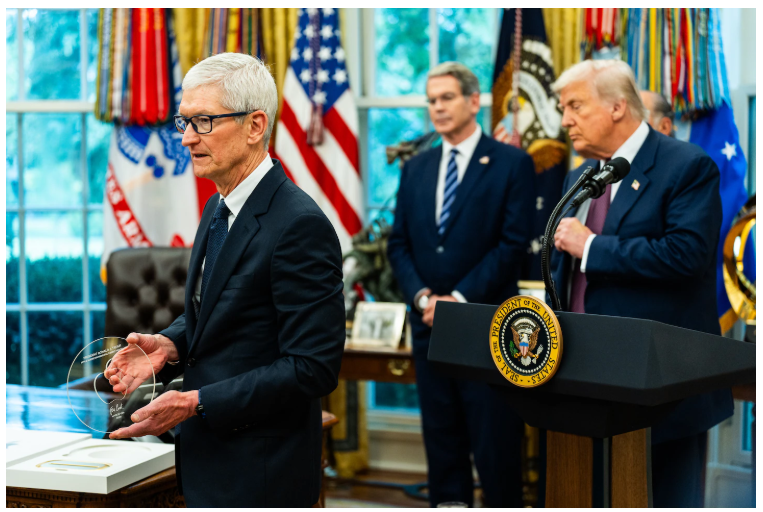
The little gift Tim Cook brought Trump—a commemorative Apple product etched with symbolism and sycophancy.
It wasn’t just silly. It was embarrassing.
A plate? For a man who has done nothing but undermine the institutions Cook claims to believe in?
That wasn’t a gesture of diplomacy. It was a metaphor for Cook’s leadership in that moment: polished, performative, and painfully small.
The CEO of the most valuable company in the world brought a trinket to a convicted felon—when what was needed was a spine.
At one point, Apple was just a scrappy startup—two guys in a garage, betting everything on a vision. Do we really think this is what they imagined decades ago? That one day, the leader of their creation would be handing a ceremonial plate to a convicted felon in the Oval Office for the sake of political favor?
At one point, Apple was just a scrappy startup—two guys in a garage, betting everything on a vision. Steve Jobs built that vision on boldness, risk, and a belief in doing things differently.
If you’re a founder today, your “Think Different” moment isn’t a marketing campaign—it’s a decision under pressure. Will you follow the crowd, or will you be the leader in that empty box on the right side of Galloway’s chart?
The Cost of Courage? Worth Every Penny.
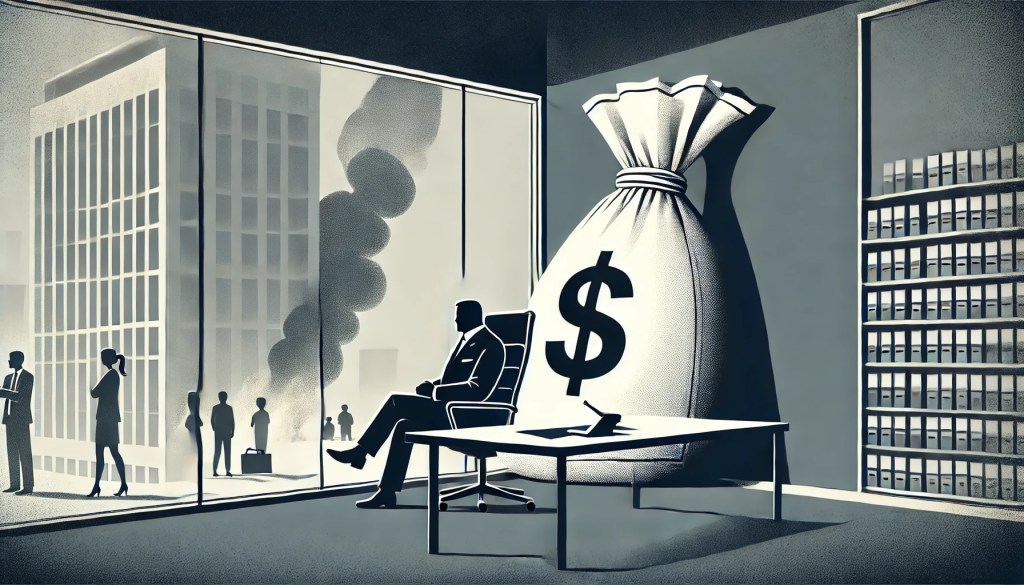
Let’s be honest—if Tim Cook had refused the photo op, if he had given Trump the middle finger instead of a handshake, the backlash would’ve come fast.
There would’ve been retaliation:
- Another Trump rant on Truth Social
- Threats of new tariffs
- Maybe even a MAGA boycott or Fox News smear campaign
- A few angry headlines, a dip in the stock, some political pressure from all the usual suspects
But who cares?
Tim Cook is worth over $2.4 billion.
Apple is valued at nearly $3.2 trillion.
If anyone had the brand equity, global presence, and moral authority to stand up to Trump—it was him. The first CEO who says no is the one history will remember.
Instead, Cook blinked. And in doing so, he told every startup founder and VC firm watching:
“Even when you have it all, it’s safer to bend the knee.”
That’s not just disappointing—it’s dangerous.
Because when the most powerful leaders play it safe, it sends the message that conviction is optional, and cowardice is strategy.
Startups don’t need more leaders who chase proximity to power.
They need leaders willing to risk something real—to protect the cultures they’re building and the people they’re leading.
Scott Galloway puts it bluntly:
“If you have a platform and resources, and you can’t speak truth in moments of crisis, then you’re not a leader — you’re just a manager with a big paycheck.”
So if you’re a founder, listen closely:
- Your team is watching you.
- Your investors are watching you.
- And someday, the world will too.
When that moment comes, what will you do? As a founder, you have freedom Big Tech doesn’t. No entrenched board politics, no corporate PR script. Use it.
This is your advantage—turn it into your moment.
Questions for Startup Founders and VC Firms
- If a major investor or political figure you disagree with publicly offers you a lucrative deal, do you take the meeting?
- If standing up for your company’s values costs you a key contract, partnership, or 10% of your annual revenue, what’s your move?
- When your company’s brand is tested in public, who speaks for it—and what will they say?
- What’s your “plate moment,” and how will you avoid it?

Article was written by John-Miguel Mitchell who is the Founder and Lead Consultant at Ekipo LLC. If you’d like to learn more about how to design and build out the ideal workplace culture for your business, email him at jmitchell@joinekipo.com.
Liked the blog? Click on the subscribe button below to get new content delivered directly to your inbox every Thursday.
 Ekipo
Ekipo 