
Written & read by John-Miguel Mitchell

In startup land, no one warns you how lonely the layoffs feel.
In startups, we love to talk about growth. Hiring sprees. Oversubscribed rounds. Scaling teams from 10 to 100. But there’s another side we don’t prepare for—the moment when the water pulls back.
At first, it feels like a pause. A slowdown. Maybe just a quiet quarter. But if you’ve been around long enough, you know what comes next: the layoff wave.
Like a tsunami, layoffs don’t always arrive with warning sirens. They follow periods of overextension, of false calm, of building pressure. And when they hit, they don’t just wash people out of the company—they reshape the culture, the trust, and the emotional terrain you thought was solid.
So the question isn’t if you’ll face a layoff. The question is: Will your culture survive it?
About 2 weeks ago, we wrote and discussed about how Windsurf‘s leadership team fell into the hands of Google, while leaving the rest of the team and infrastructure adrift. Shortly after the reverse acqui-hire, Cognition came in and acquired the rest of the AI startup. Within three weeks:
- 30 employees were laid off
- 200 were offered buyouts worth nine months of pay
- Remaining staff were expected to work 80+ hour weeks, six days a week, in-office
The backlash was swift. Employees felt betrayed. Observers said it “broke the Silicon Valley social contract.” But here’s the part founders rarely say out loud: What happens when you have to shrink—on someone else’s timeline?
Because if you took venture funding, you likely scaled under a powerful narrative:
“Grow at all costs. Hire fast. Burn now, profit later.”
And now? That narrative has flipped.
“Cut headcount. Extend runway. Get lean or get left behind.”
This reversal creates a brutal narrative tension for founders: The same investors who pushed for aggressive growth are now asking you to lay off the very people you hired. And in the middle of that tension?
- Your culture.
- Your leadership.
- Your team’s belief in you.
This story never or better said, strategy never seems to have a happy ending. I’ve seen it too many times: founders pushed to scale fast, then told to cut just as quickly—often by the same people who once cheered their hiring spree. But layoffs aren’t just about headcount. They test your leadership, your values, and your culture in ways growth never will. When the narrative flips, the real challenge isn’t financial—it’s whether you can lead with clarity, integrity, and care when it matters most.
Behind the Headcount: A Culture Under Pressure
If the cultural impact of layoffs feels anecdotal, the data tells a sobering story.
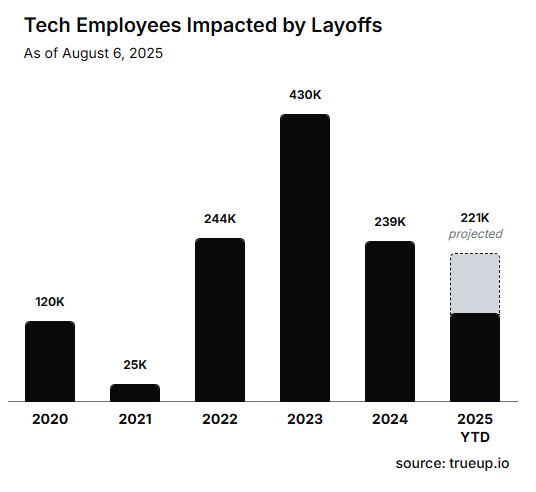
Since 2022, the tech industry has endured a historic wave of job cuts, with 2023 alone impacting over 430,000 employees. And 2025 is on track to surpass 220,000—despite early optimism about market recovery.
These aren’t just numbers—they’re shockwaves that ripple through startup teams, altering trust, morale, and the emotional contract between founders and their people.
As layoffs become more common—and often more sudden—the cultural damage becomes more permanent when founders treat them as routine cost cuts instead of leadership crucibles.
Layoffs Aren’t Just Financial Decisions. They’re Cultural Crossroads.
Most founders think the hardest part of a layoff is the math.
In reality, the hardest part is the mirror.
- How do you lead when the growth narrative collapses?
- What do your values mean under pressure?
- How do you keep the team believing in the mission when it feels like you’re backtracking?
Because the truth is, most startups won’t die from a bad quarter. They’ll die from a broken culture they never repaired.
⚔️ Counter-Points: What Critics Might Say
| Criticism | Response |
|---|---|
| “You’re over-empathizing. Layoffs are financial realities.” | True. But culture drives productivity and retention. Without trust, the cost-benefit flips. |
| “VCs did push for cuts. Isn’t it just business?” | Yes—but founders own the message. Silence makes it feel externally imposed. |
| “Startups are supposed to be hard.” | Sure, but opt-in hardship is different from unexpected cultural whiplash. |
| “If they can’t handle high burn, they’re not a fit.” | Misalignment isn’t about toughness. It’s about clarity and consensus. |
📅 Real Startup Layoff Stories: What Worked, What Broke

❌ Better.com (2021)
900 employees laid off over Zoom, abruptly, with no empathy.
Fallout: Employer brand tanked. CEO credibility collapsed.
❌ Bird (2022)
Employees learned of layoffs via lost Slack access.
Fallout: Mass confusion, distrust, and morale nosedive.
✅ Airbnb (2020)
Brian Chesky’s transparent letter laid off 25% of staff with dignity, context, and support.
Result: Trust preserved. Alumni became advocates.
✅ Stripe (2022)
The Collison brothers took full responsibility for strategic missteps, offered generous support.
Result: Employees felt respected—even those exiting.
The Cultural Fallout: By the Numbers

- 64% of employees no longer trust their companies after a massive layoff leadership less after mass layoffs.
- After layoffs, confidence in the company can drop almost 17% and confidence in leadership can drop almost up to 11%. See below:

- Surviving employees are not going to work any harder, in fact we see there’s a 41% drop in job satisfaction post-layoff.
🛠️ Quick Wins: Short-Term and Long-Term Cultural Strategy
Short-Term (0–4 weeks)
- Launch candid all-hands: Share the decision timeline and reasoning. Founder-led messaging matters.
- Clarify buyouts vs. staying expectations: Ensure fairness and agency.
- Check in weekly with survivors: Structured pulse meetings reinforce safety and values.
- Recognize the layoff publicly: Transparency rebuilds narrative control.
Mid to Long Term (1–6 months)
- Reaffirm the culture contract: Revisit values. Do they still hold?
- Invest in upskilling or role shifts: Show commitment to those staying.
- Engage VCs on messaging alignment: Culture is a lever, not a liability.
- Host a cultural reset event: Rituals matter in regaining trust.
Founders Set the Tone. Even in the Quiet.

So if you’re a founder reading this, ask yourself:
- What’s our plan if we need to downsize in 90 days?
- Have we stress-tested our values under pressure?
- Who helps us navigate the emotional side of team change—not just the legal or financial side?
Because your next big leadership moment might not be a pitch.
It might be a layoff. And culture, more than capital, will determine whether your company survives it.
Layoffs, like tsunamis, don’t just destroy what’s visible. They expose what was fragile underneath. The trust gaps. The unspoken fears. The culture that sounded good on paper but hadn’t been pressure-tested yet.
Founders often assume the hard part is letting people go. But the real challenge is what happens after the wave—when the dust settles and the team looks to you for what’s next.
- What story will they believe?
- What values will they still see lived?
- What pieces of the culture will remain standing?
You can’t stop the wave. But you can shape what survives it.
And that’s why the most resilient companies aren’t the ones that scaled the fastest. They’re the ones that remembered who they were when the water pulled back.

Article was written by John-Miguel Mitchell who is the Founder and Lead Consultant at Ekipo LLC. If you’d like to learn more about how to design and build out the ideal workplace culture for your business, email him at jmitchell@joinekipo.com.
Liked the blog? Click on the subscribe button below to get new content delivered directly to your inbox every Thursday.
 Ekipo
Ekipo 