
Read and written by John-Miguel Mitchell
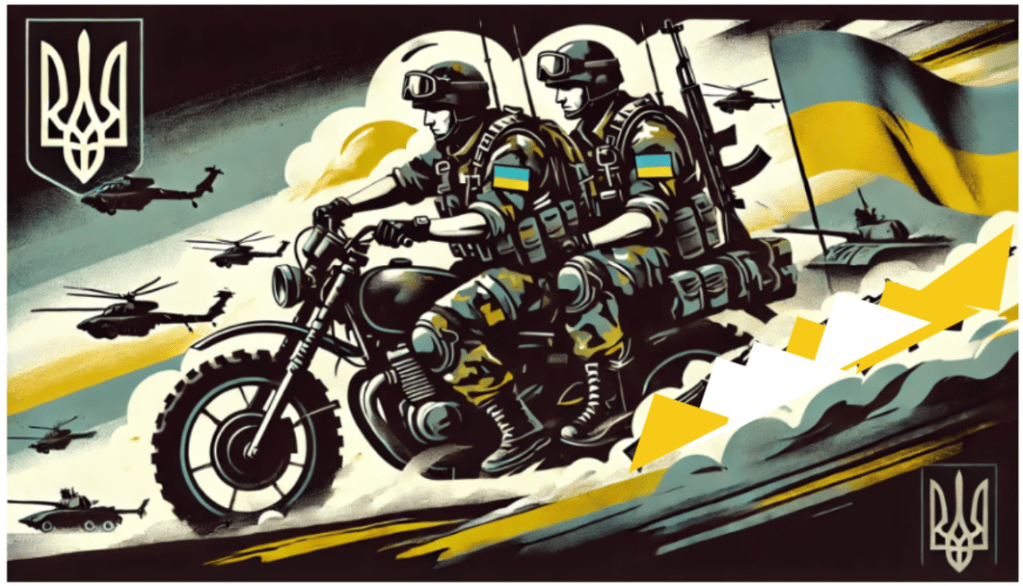
I was out of town last week so forgive me if this headline feels a little outdated. A couple of weeks ago, I read a fascinating article about Ukraine’s biker squads—two-wheeled “cavalry” units trained to outmaneuver Russian drones using speed, grit, and adaptability. These soldiers operate in pairs, making rapid decisions in high-stakes environments. Their strategy? Stay lean, stay alert, and trust your partner.
What does this have to do with workplace culture in startups and VC-backed firms? More than you might think.
In high-velocity, uncertain environments, success belongs not to the well-resourced but to the culturally cohesive. The same principles that keep Ukrainian biker squads alive under drone fire are what separate breakout startups from those that collapse under pressure.
Peter Drucker once said:

Startups and VC firms often try to scale with playbooks meant for more stable environments. But in a fast-moving, volatile market, yesterday’s logic is a liability.
Let’s unpack what Ukrainian biker squads can teach startup leaders—and how today’s tech headlines reinforce these lessons:
🏍 1️⃣ Small, Adaptable Teams Win
Ukraine’s biker units aren’t battalions—they’re agile pairs trusted to respond in real time. They’re effective because they’re small, fast, and empowered to make decisions without waiting for headquarters approval.
The same logic powers breakout startups. Take Perplexity, the AI search engine that just processed 780 million queries in May—a 20% month-over-month spike. That kind of velocity isn’t achieved through bureaucratic approvals. It’s driven by autonomous, context-rich teams iterating quickly and decisively.
🔗 Lesson: In volatile markets, team size isn’t about headcount—it’s about decision speed.
🧠 2️⃣ Context Beats Control

Biker squads navigate by terrain, drone activity, and weather—not rigid command structures. Their survival depends on real-time information and the authority to act on it.
Amazon‘s development of humanoid robots for last-mile delivery exemplifies this principle. To build and deploy something so experimental, Amazon‘s teams need immediate feedback loops and cultural permission to pivot. The teams succeeding aren’t waiting on executive memos—they’re trusted with the “why” and empowered to figure out the “how.”
🔗 Lesson: The best managers in uncertain environments act as intelligence providers, not decision bottlenecks.
Quick Lesson From History

During World War II, British paratroopers carried folding bicycles—the lightweight BSA Airborne model—on missions behind enemy lines, including the D-Day invasion. These bikes allowed them to land, deploy quickly, and navigate terrain without relying on slow-moving vehicles or supply chains.
They were a symbol of resourceful mobility: not fast because of power, but fast because of design.
🔗Lesson: Don’t build your startup like a tank battalion—build it like a paratrooper squad. Lightweight, empowered, and ready to execute under pressure.
🔥 3️⃣ Culture Is Armor, Not Aesthetic

Ukraine’s squads can’t afford internal politics or misalignment. They live or die by cohesion. In startups, workplace culture often gets framed as perks or vibes—but under pressure, it’s your shock absorber.
Look at xAI, Elon Musk’s AI company, now navigating investor turbulence due to his public clash with Trump. With $5B on the line, investors are spooked—not by product, but by potential instability. The message is clear: a misaligned or fragile workplace culture can tank momentum, no matter how technically advanced you are.
Or consider Anduril, which just raised $2.5B for its defense tech. You don’t build wartime-grade innovation by accident. You build it through trust, coordination, and cultural clarity.
🔗 Lesson: Workplace culture isn’t just a competitive advantage—it’s your ability to withstand chaos.
🧭 The Action Framework: Building Biker Squad Culture
Quick Wins (This Week):
- Cut the friction: Eliminate one meeting or approval layer slowing your team.
- Share context: Give teams real-time access to customer data and strategic goals.
- Diagnostic check: Run a 15-minute team session asking: “What helps us move fast? What slows us down?”
Short-Term (Next 90 Days):
- Form nimble pods: Create 2–5 person squads with clear missions and decision authority.
- Document decisions: Start a lightweight decision log tracking what’s decided and why.
- Define operational culture: Build a living guide addressing how you disagree, decide, and escalate.
Long-Term (3–12 Months):
- Make culture measurable: Track decision speed and team alignment alongside traditional KPIs.
- Scale trust, not control: Shift from founder-dependent to team-empowered decision-making.
- Hire for resilience: Screen for adaptability and performance under pressure, not just credentials.
Why This Matters Now
Ukrainian biker squads excel because they’ve built systems that work when traditional structures fail. They trust their partners, make decisions with incomplete information, and adapt faster than their threats can evolve.
Your startup faces different challenges, but the principle remains: small, trusted, context-rich teams with cultural alignment will outmaneuver larger, better-funded competitors slowed by their own complexity.
The question isn’t whether you’ll face your “drone moment”—it’s whether your culture will help you navigate through it or become another casualty of it.
For a deeper dive into how team dynamics and culture impact startup performance, I’ve written more about it here: How Team Dynamics Can Make or Break Your Startup.
Questions for Startup Founders & VCs
- If a critical decision needed to be made in your company right now and you weren’t available, how many people would feel empowered to make it—and would they all make roughly the same choice?
- What’s the longest your team has to wait for approval on something that directly impacts customer experience or product development?
- When was the last time your culture was actually tested under real pressure, and what did you learn about where it holds strong versus where it breaks down?
- How do you evaluate whether a founding team’s culture can withstand the inevitable scaling pressures and market turbulence that will test every assumption they have about how they work together?

Article was written by John-Miguel Mitchell who is the Founder and Lead Consultant at Ekipo LLC. If you’d like to learn more about how to design and build out the ideal workplace culture for your business, email him at jmitchell@joinekipo.com.
Liked the blog? Click on the subscribe button below to get new content delivered directly to your inbox every Thursday.
 Ekipo
Ekipo 