
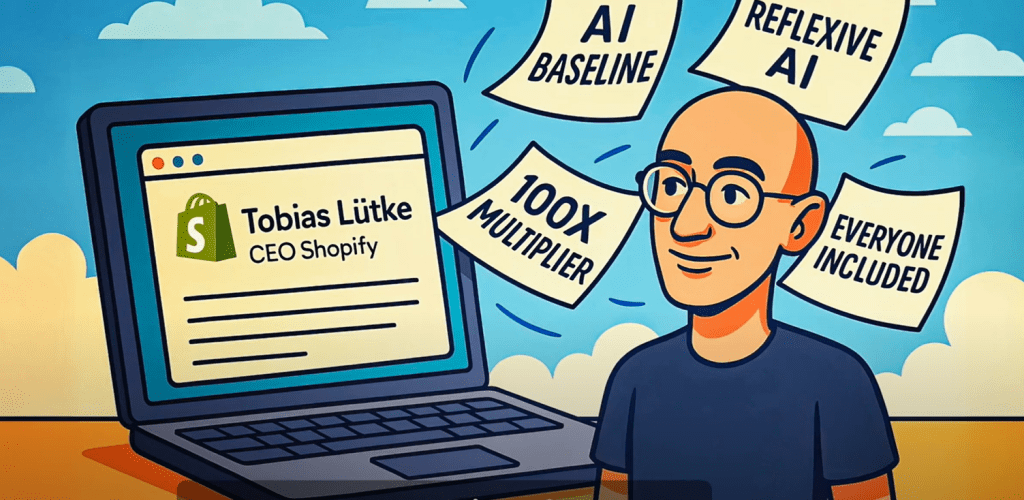
I’ll be honest—the following headline kind of upset me at my core.
“AI usage is now baseline expectation.”
That was the opening line of a leaked memo where Spotify’s CEO Tobi Lütke informed employees they must first prove a task can’t be done with AI before requesting additional resources or headcount. Apparently AI usage is now even part of performance reviews.
As someone who’s spent my career helping candidates land great opportunities and helping companies build resilient cultures, I couldn’t read this without feeling a deep unease. Not because I’m anti-AI. Far from it. But because this memo reflects a growing trend in tech that prioritizes efficiency over empathy, and automation over trust.
And here’s the kicker: even with all the hype, AI hasn’t delivered significant ROI for most companies—especially those that overlook the human side of implementation. According to a McKinsey study, the majority of U.S. executives say AI has had no impact or even increased costs for their business. That’s a huge red flag for startup founders racing to adopt AI without laying the cultural groundwork first.

This stopped me in my tracks to say the following out loud while I was walking the dog (luckily nobody was around): Are we moving too fast with systems that promise scale, but quietly chip away at the very relationships that make great teams possible?
When AI Becomes a Gatekeeper, Culture Starts to Rot

The more I reread Shopify’s new directive, the more I was convinced that the underlying message wasn’t about innovation—but about control. It reframes AI from being a collaborative tool to a barrier: You don’t get help until you’ve exhausted the machines.
That’s not empowerment. That’s austerity.
Instead of building a culture where teams are supported to explore how AI might enhance their work, Shopify has made it a prerequisite for being taken seriously.
Here’s the problem with that approach:
- It erodes psychological safety.
- It discourages experimentation.
- And it quietly implies that people are less valuable than the tools they use.
That’s not the future of work—it’s a future of fear.
Founders: Efficiency Is Not the Same as Leadership

It’s easy for startup leaders and VC firms to see this as a bold move. It sounds lean. Scalable. “Next-gen.” But if we don’t interrogate this mindset, we risk creating companies that look great on paper—and feel miserable on the inside.
You can’t build long-term value on short-term pressure. Burnout, disengagement, and turnover are the hidden costs of hyper-efficiency. And make no mistake—investors will feel those losses, too.
Sorry boss but when the narrative becomes “prove you deserve help,” you’ve already lost the plot.
A Better Path: How Founders Can Lead with AI and Humanity

Don’t get me wrong, AI should absolutely be part of your company’s growth story. But there’s a better way to bring it in—one that honors both progress and people. Here’s how:
1. Make AI an invitation, not an ultimatum
Invite teams to pilot AI tools and give feedback. Let them shape how AI is integrated into workflows, rather than forcing them to prove AI can’t do their jobs.
2. Incorporate AI training into onboarding and upskilling
Don’t just expect people to use AI—equip them. Invest in low-lift, high-impact training that helps employees feel confident using new tools.
3. Measure learning, not just usage
Instead of adding “AI usage” to performance reviews, ask how employees are learning and experimenting with AI. Reward curiosity, not just compliance.
4. Co-design AI policies with your team
Culture is built through participation. If you’re implementing AI mandates, involve your people in the process. Create space for concerns, ideas, and iteration.
5. Keep people at the center
Every new AI tool should answer one question: How does this help our people do their best work? If you can’t answer that, don’t implement it yet.
Lütke concludes his statement by saying, “Our job is to figure out what entrepreneurship looks like in a world where AI is universally available. And I intend for us to do the best possible job of that, and to do that I need everyone’s help.” While that sentiment is indeed valid and reflects a forward-thinking approach, I would tread lightly with any strategy that treats human input as a last resort. Why? Because the integration of AI into entrepreneurship presents both opportunities and challenges that we must navigate carefully.
Tools may evolve, but people still need clarity, trust, and psychological safety to thrive. If we push teams to rely on AI before they can even ask a colleague for support, we risk trading collaboration for isolation, and creativity for compliance. Founders have an opportunity right now: to lead with intention, build workplaces where AI supports—not replaces—human connection, and ensure that culture doesn’t get lost in the race for stuff done faster and better.
The Bottom Line:
- AI should be a tool, not a test. Use it to support people—not to prove they’re replaceable.
- Culture can’t be an afterthought. Founders must lead with both innovation and empathy.
- Real progress is human-centered. Sustainable growth comes from trust, not just tech.
Questions for Founders and Investors:
- Are your teams empowered to explore AI—or pressured to prove themselves against it?
(If the latter, what does that say about the culture you’re building?) - What systems are in place to ensure psychological safety as you integrate new technology?
(Because innovation can’t thrive where people are afraid to fail.) - Are you investing as much in your people’s readiness and trust as you are in the tools themselves?
(AI without culture is just automation. And automation without alignment creates risk, not scale.)

Article was written by John-Miguel Mitchell who is the Founder and Lead Consultant at Ekipo LLC. If you’d like to learn more about how to design and build out the ideal workplace culture for your business, email him at jmitchell@joinekipo.com.
Liked the blog? Get new content delivered directly to your inbox every Thursday.
 Ekipo
Ekipo 