

We’ve heard it too many times.
“You can’t measure workplace culture! You can’t define it! It’s impossible.”
Well, at Ekipo, we’ve encountered this complaint more than once, and we’re here to debunk the myth that workplace culture is elusive and immeasurable.
Myth #1: Workplace culture is too intangible and complex.
False.
There are specific elements (purpose, management structure, leadership style, workplace practices & policies, visual artifacts) to a workplace culture that shape how work gets done and how employees interact.
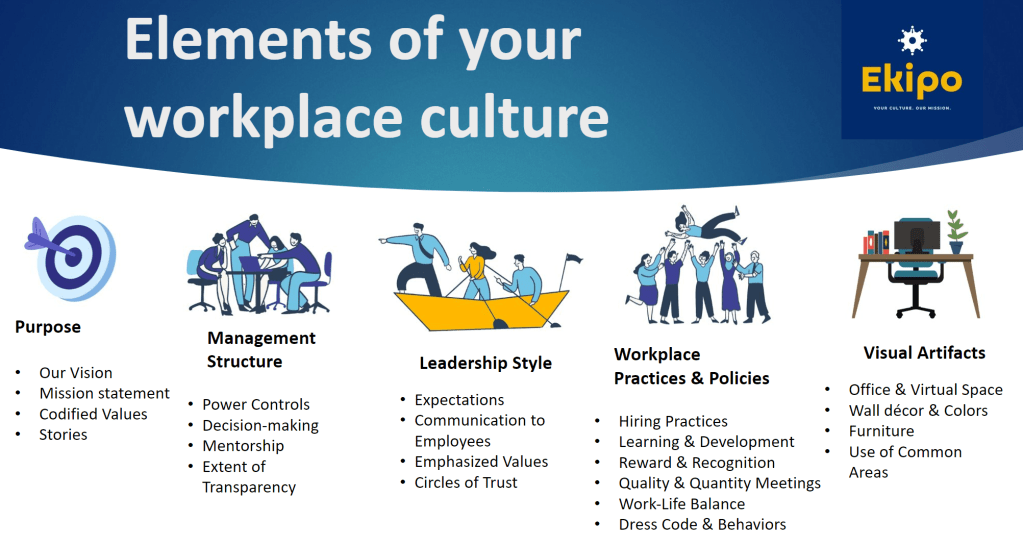
If any one of these elements are ignored, postponed or taken lightly–it can drastically change the employee engagement, productivity, and overall success of your company. Just ask yourself the following:
- Have you sat in a quarterly townhall meeting where the company only talks about generating “more revenue” and not about their overall purpose?
- Have you have worked with a leader that was reluctant in delegating any decisions?
- Have you every dealt with a toxic manager that never valued work-life balance–not even for themselves?
- Have you experienced the confines of a windowless office, shrouded in the sterile glow of fluorescent lights?
In an era where attracting, engaging, and retaining talent is a top priority for companies, focusing on how we measure and define these workplace culture elements has never been more critical.
Myth #2: There aren’t quantitative metrics for workplace culture.
False.
I once overheard a boss share the followng to a client, “You can find solace in the numbers.” So true.
While culture itself may not be directly measurable (like sales revenue, profit margins or customer satissfaction rates), its impact can be assessed through various quantitative metrics. Employee engagement surveys, turnover rates, absenteeism, and productivity metrics can provide valuable insights into the health and effectiveness of your workplace culture.

These metrics are like signposts that guide us in understanding the culture’s impact on employees and the organization as a whole. By analyzing trends and patterns in these metrics, you can identify areas of strength and areas that require improvement, allowing you to make data-driven decisions to shape your culture.
Myth #3: Qualitative data is really hard to capture.
False.
In reality, qualitative assessments such as focus groups, interviews, workshops and “culture walks” can provide deeper insights into your workplace culture. They provide the “why” behind the numbers.
Asking senior leadership and entry-level employees questions like the following can uncover lots of beliefs, attidudes and behaviors that are hidden beneath the surface:
- Does our senior team talk about culture as often as we talk about costs, profit, and business performance?
- Why do you like working here and what motivates you to come to work every day?
- How would you describe your company culture in 5 words?
- What is the one thing you would most like to change about this organization? ”
When we visit a company and observe their office layout, decorations, and the way spaces are organized, that “walk” can provide valuable insights into the culture of that organization. For instance, an open floor plan might indicate a culture of collaboration and transparency, while closed offices or cubicles could suggest a more hierarchical or private culture. In the realm of aesthetics, a tech startup might have a more casual and playful vibe with colorful artwork, while a law firm may opt for a more formal and traditional decor.
For instance, an open floor plan might indicate a culture of collaboration and transparency, while closed offices or cubicles could suggest a more hierarchical or private culture.

In the realm of aesthetics, a tech startup might have a more casual and playful vibe with colorful artwork, while a law firm may opt for a more formal and traditional decor.

These methods allow you to gather subjective feedback and perspectives from employees, helping to identify cultural values, norms, and areas for improvement.
Cultural Pivot Roadmap:
Once we reveal the gaps between your actual culture and the ideal culture that you’re striving for, our workplace culture experts can help you create the roadmap that allows your company to pivot workplace culture elements with measurable goals and milestones that will track progress and adjust strategies as needed. It’s like having a GPS for your cultural journey, ensuring you stay on the right path and reach your destination.
While workplace culture may not be easily quantifiable like financial metrics, it is possible to measure, define, and shape it through a combination of quantitative and qualitative approaches.
Remember, the power to influence your culture is in your hands, and with the right tools and guidance, it can be done. So, if you’ve ever doubted the measurability of workplace culture, consider reaching out to our firm who can help you demystify this crucial aspect of your company.
Article was written by John-Miguel Mitchell who is a Lead Consultant at Ekipo LLC. If you’d like to learn more about how to design and build out the ideal workplace culture for your business, email him at jmitchell@joinekipo.com.
 Ekipo
Ekipo 